Brachiosaurus: Facts, Size, Diet, Habitat & Discovery
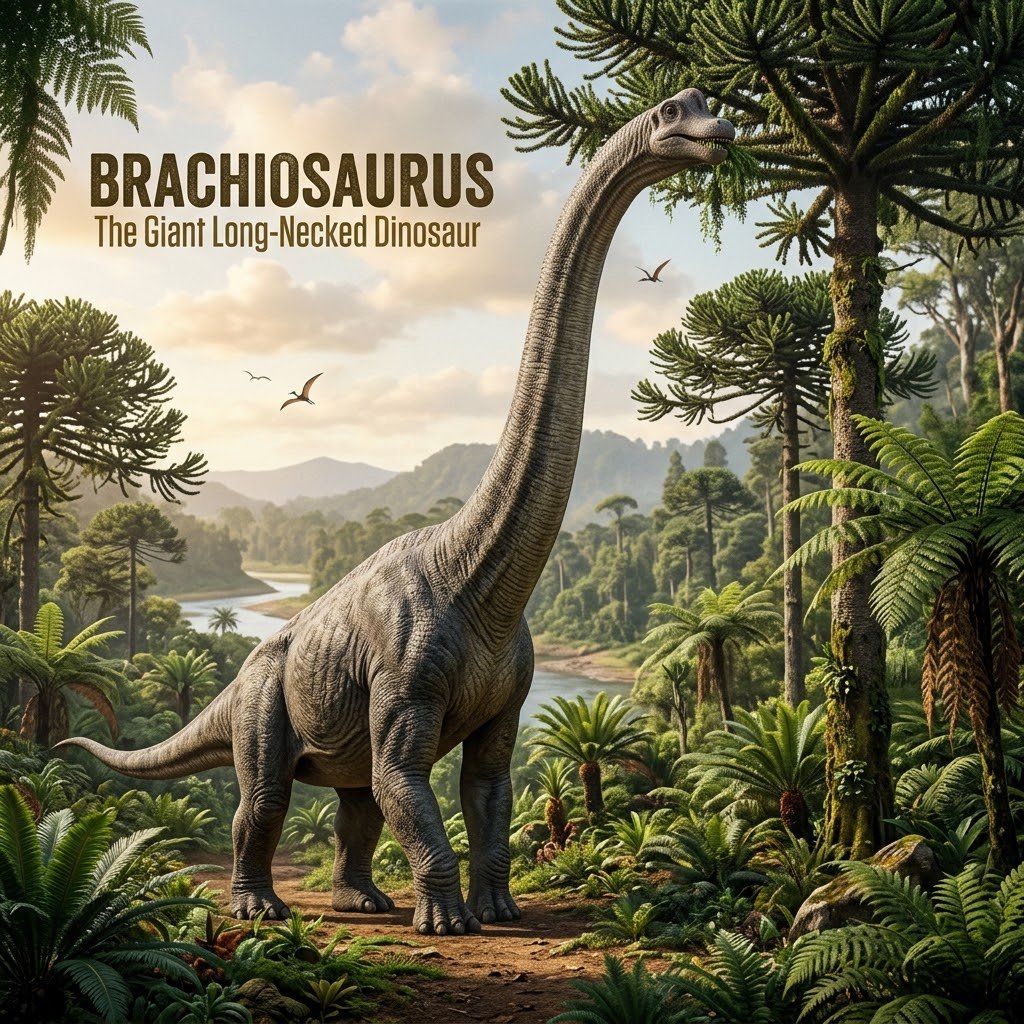
Brachiosaurus: The Giant Long-Necked Dinosaur
Millions of years ago, during the Jurassic Period, some of the largest animals ever to walk on Earth lived across ancient landscapes. Among these incredible creatures was Brachiosaurus, a massive long-necked dinosaur famous for its enormous body, unusually long front legs, and towering neck. It was one of the most remarkable plant-eating dinosaurs of its time.
Brachiosaurus is especially interesting because its body structure allowed it to reach vegetation high above the ground. Its impressive size and unique physical features make it one of the most recognizable dinosaurs in prehistoric history.
In this article, we will explore the discovery, appearance, size, diet, habitat, behavior, and other fascinating facts about Brachiosaurus.
What Was Brachiosaurus?
Brachiosaurus was a large herbivorous dinosaur that lived approximately 154 to 150 million years ago during the Late Jurassic Period. Its fossils were first discovered in North America, particularly in the Morrison Formation, a famous geological region known for its rich dinosaur fossils.
The name Brachiosaurus means “Arm Lizard.” It comes from the Greek words brachion, meaning arm, and sauros, meaning lizard. This name refers to its unusually long front legs, which were longer than its hind legs.
Unlike many other long-necked dinosaurs, Brachiosaurus had a body structure that made its shoulders higher than its hips. This gave it a distinctive upright appearance.
Scientists classify Brachiosaurus as a sauropod dinosaur. Sauropods were a group of enormous plant-eating dinosaurs characterized by long necks, long tails, thick legs, and relatively small heads.
How Big Was Brachiosaurus?
Brachiosaurus was one of the largest land animals of its time. Its enormous body and long neck allowed it to stand much taller than most other dinosaurs.
Based on the fossil evidence, Brachiosaurus is estimated to have reached approximately 18 to 22 meters (59 to 72 feet) in length. Its height at the head may have reached around 12 to 13 meters (39 to 43 feet), although estimates vary depending on the specimen and reconstruction.
Its weight is commonly estimated at around 30 to 50 metric tons.
One of the most interesting features of Brachiosaurus was its long front legs. Unlike many other sauropods, its front limbs were noticeably longer than its back limbs. This body structure helped position its neck at a high angle, making it easier to reach vegetation growing high above the ground.
Its enormous size also provided some protection against predators. Fully grown adults would have been extremely difficult for most meat-eating dinosaurs to attack successfully.
What Did Brachiosaurus Look Like?
Brachiosaurus had a distinctive appearance that made it different from many other sauropod dinosaurs.
Its most noticeable feature was its extremely long neck, which extended high above its body. The neck allowed it to reach leaves and branches that were difficult for smaller herbivores to access.
Its body was large and heavy, supported by four thick legs that acted like pillars. These strong limbs helped carry its enormous weight while walking across the Jurassic landscape.
Brachiosaurus also had a relatively small head compared with its massive body. Its skull contained nostril openings positioned high on the head, although the exact function and placement of these features have been subjects of scientific discussion.
Another important feature was its long, muscular tail, which helped balance its body.
Together, these physical characteristics made Brachiosaurus one of the most unusual and impressive dinosaurs ever discovered.
What Did Brachiosaurus Eat?
Brachiosaurus was a herbivore, meaning it survived entirely on plant material. During the Jurassic Period, forests contained many types of plants, including conifers, cycads, ferns, and other ancient vegetation.
Its long neck provided a major advantage when searching for food. It could reach leaves growing high in trees without needing to move its entire body constantly.
Brachiosaurus likely consumed large quantities of vegetation every day to maintain its enormous body. Like other sauropods, it swallowed plant material without thoroughly chewing it. Food was processed further inside its digestive system.
Its peg-like teeth were suitable for stripping leaves and other vegetation from plants rather than chewing tough food like modern herbivores with grinding teeth.
The ability to feed at different heights may have allowed Brachiosaurus to use food resources that were less accessible to other plant-eating dinosaurs.
Where Did Brachiosaurus Live?
Brachiosaurus lived during the Late Jurassic Period, approximately 154 to 150 million years ago.
Its fossils have been discovered in North America, particularly in areas that are now part of the western United States. During the Jurassic Period, these regions had a much warmer environment than many of them experience today.
The landscape included river systems, floodplains, forests, and areas with abundant vegetation. These environments provided the plant food needed to support enormous herbivorous dinosaurs.
A closely related brachiosaurid dinosaur, Giraffatitan, lived in what is now Tanzania, Africa. It was once classified as Brachiosaurus brancai, but scientists later recognized it as a separate genus.
This distinction is important because many older dinosaur books and documentaries use the name Brachiosaurus for both animals.
How Did Brachiosaurus Move?
Despite its enormous size, Brachiosaurus was capable of moving on all four legs.
Its legs were thick and strong, supporting its heavy body as it walked across the ground. Its movement was probably slow and steady compared with smaller animals.
Its long neck and tail helped maintain balance while moving. However, scientists continue to study how sauropods controlled their neck movements and distributed their body weight.
Brachiosaurus was not built for running at high speeds. Its massive size required considerable energy to move, and its strong limbs were better suited to supporting its weight during walking.
There is also no strong evidence that Brachiosaurus regularly stood on its hind legs to feed. Its unusual body proportions already allowed it to reach considerable heights while standing normally.
Was Brachiosaurus Dangerous?
Brachiosaurus was not a meat-eating dinosaur, so it did not actively hunt other animals. However, its enormous size made it a powerful animal.
Although it was generally a peaceful plant-eater, it probably had ways to defend itself against predators.
Its massive body, powerful legs, and long tail may have helped discourage attacks. A powerful kick or movement from such a large animal could have caused serious injuries to a predator.
During the Jurassic Period, large carnivorous dinosaurs such as Allosaurus lived in the same general region. Young or vulnerable sauropods may have been at greater risk from these predators than healthy adults.
Brachiosaurus vs. Other Long-Necked Dinosaurs
Brachiosaurus belonged to the sauropod group, which included many other giant long-necked dinosaurs.
Some of its well-known relatives and other sauropods included Diplodocus, Apatosaurus, and Camarasaurus.
Although these dinosaurs shared certain characteristics, they had important differences.
Diplodocus had an extremely long, slender body and tail, with a different neck structure and shorter front limbs relative to its hind limbs.
Apatosaurus had a much heavier body and a relatively shorter neck compared with Brachiosaurus.
Camarasaurus had a shorter, deeper skull and a more compact body structure.
Brachiosaurus stood out because of its longer front legs and elevated shoulder region, which gave it a distinctive high-reaching posture.
How Was Brachiosaurus Discovered?
The first Brachiosaurus fossils were discovered in 1900 by American paleontologist Elmer S. Riggs during an expedition in western Colorado, United States.
The discovery was scientifically important because the fossils represented a previously unknown type of giant sauropod.
In 1903, Riggs officially described and named the dinosaur Brachiosaurus altithorax.
The name altithorax refers to its deep chest, another characteristic feature of this enormous dinosaur.
Since its discovery, Brachiosaurus has become one of the most famous dinosaurs in the world. Its fossils have helped scientists understand the diversity, anatomy, and evolution of sauropod dinosaurs.
Interesting Facts About Brachiosaurus
Here are some fascinating facts about this giant dinosaur:
- Brachiosaurus lived approximately 154 to 150 million years ago.
- Its name means “Arm Lizard.”
- It was a plant-eating dinosaur.
- Its front legs were longer than its hind legs.
- It could reach vegetation growing high above the ground.
- It belonged to the sauropod group of dinosaurs.
- Its fossils were first discovered in Colorado, United States.
- Its scientific name is Brachiosaurus altithorax.
- It had a relatively small head compared with its enormous body.
- It lived during the Late Jurassic Period.
- It shared its environment with predators such as Allosaurus.
- It was one of the most recognizable giant dinosaurs in popular culture.
Why Is Brachiosaurus Important to Paleontology?
Brachiosaurus is important because it provides valuable information about how giant sauropod dinosaurs evolved and adapted to their environments.
Its unusual body proportions help scientists understand the different feeding strategies that existed among long-necked dinosaurs.
The study of its skeleton also provides information about how enormous animals supported their weight, moved across the land, and obtained enough food to survive.
By comparing Brachiosaurus with other sauropods, paleontologists can investigate how different dinosaur groups developed unique body structures and occupied different ecological roles.
Its discovery also contributed to a better understanding of the remarkable diversity of dinosaurs that lived during the Jurassic Period.
Conclusion
Brachiosaurus was truly one of the most extraordinary dinosaurs to ever walk on Earth. With its enormous body, towering neck, long front legs, and plant-eating lifestyle, it was perfectly adapted to life in the Jurassic environment.
From reaching vegetation high above the ground to supporting its massive body with powerful legs, every part of its structure tells an interesting story about prehistoric life.
Even today, Brachiosaurus continues to capture the imagination of dinosaur enthusiasts, students, and scientists. Its fossils remind us how diverse and incredible the ancient world was and how much we can learn by studying the remains of animals that lived millions of years ago.