Triceratops: Everything You Need to Know About the Three-Horned Dinosaur
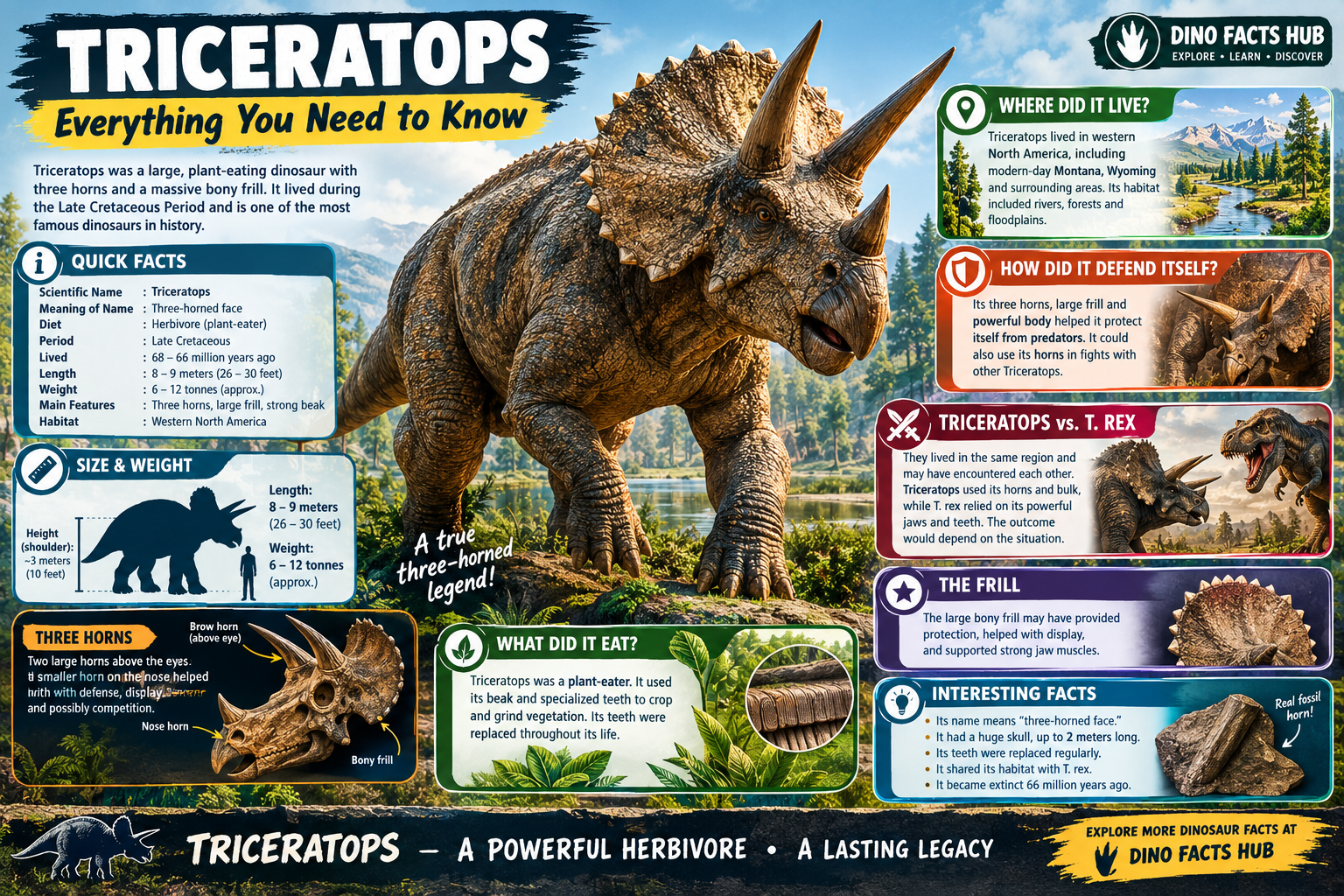
Have you ever wondered what it would be like to stand face-to-face with a dinosaur that had three enormous horns, a massive bony frill, and the strength to defend itself against some of the most dangerous predators of the prehistoric world? Meet Triceratops, one of the most recognizable dinosaurs that ever lived!
Triceratops was a large, plant-eating dinosaur that lived millions of years ago during the Late Cretaceous Period. Its impressive horns, powerful body, and distinctive head made it one of the most fascinating animals of its time.
In this guide, we will explore Triceratops facts, size, diet, horns, habitat, fossils, and its possible encounters with Tyrannosaurus rex. Whether you are a dinosaur enthusiast, a student, or simply curious about prehistoric animals, there is plenty to discover.
Quick Facts About Triceratops
- Scientific name: Triceratops
- Meaning of name: Three-horned face
- Diet: Herbivore (plant-eater)
- Period: Late Cretaceous
- Lived: Approximately 68–66 million years ago
- Length: Around 8–9 meters (26–30 feet)
- Weight: Approximately 6–12 tonnes, depending on the individual and estimate
- Main features: Three facial horns, a large bony frill, and a strong beak
- Habitat: Western North America
- Famous relative or rival: Tyrannosaurus rex
Table of Contents
- What Was Triceratops?
- How Big Was Triceratops?
- Why Did Triceratops Have Three Horns?
- What Did Triceratops Eat?
- Where Did Triceratops Live?
- How Did Triceratops Defend Itself?
- Triceratops vs. T. rex
- What Was the Triceratops Frill Used For?
- How Did Triceratops Move?
- Interesting Triceratops Facts
- How Was Triceratops Discovered?
- Why Did Triceratops Become Extinct?
- Frequently Asked Questions
- Conclusion
1. What Was Triceratops?
Triceratops was a large, four-legged dinosaur belonging to a group called ceratopsians, which were known for their distinctive horns and frills. It lived near the end of the Cretaceous Period, shortly before the mass extinction that wiped out all non-avian dinosaurs.
Its name comes from Greek words meaning “three-horned face.” The name perfectly describes its most noticeable feature: two long horns above the eyes and a smaller horn on the nose.
Triceratops had a large head, a strong body, thick legs, and a short tail. Its skull was particularly impressive, making up a substantial portion of its overall length.
Although it looked intimidating, Triceratops was a herbivore. It did not hunt other dinosaurs for food. Instead, it used its beak and teeth to feed on vegetation.
Scientists have discovered numerous Triceratops fossils, including skulls, horns, and other skeletal remains. These discoveries help researchers understand how this dinosaur lived, fed, and interacted with its environment.
2. How Big Was Triceratops?
Triceratops was one of the largest horned dinosaurs ever discovered. Its enormous body helped protect it from predators, while its strong legs supported its considerable weight.
Triceratops Size and Weight
Adult Triceratops could reach approximately 8–9 meters (26–30 feet) in length. Estimates of its weight vary, but many large adults are thought to have weighed several tonnes, with some estimates reaching around 6–12 tonnes.
Its skull was especially remarkable. Large specimens had skulls measuring around 2 meters or more in length, including the impressive frill.
Here is a closer look at its approximate dimensions:
- Length: 8–9 meters
- Weight: Roughly 6–12 tonnes in large adults, depending on the estimate
- Body posture: Four-legged
- Head: Large skull with three facial horns
- Tail: Relatively long and muscular
These measurements are estimates based on fossil remains. Not every Triceratops reached the same size, and scientists continue to study differences between individual specimens.
How Did Triceratops Compare With Humans?
An adult Triceratops was far larger and heavier than a human. Its head alone could be taller than an adult person, and its body stretched several times the length of an average human’s height.
Its size would have made it a formidable animal to approach, especially when threatened or protecting itself.
3. Why Did Triceratops Have Three Horns?
The three horns are the main reason Triceratops is so famous. Two large horns extended above its eyes, while a smaller horn projected from its nose.
But why did it have these unusual features?
Scientists believe the horns may have served several purposes.
Protection Against Predators
The horns may have helped Triceratops defend itself against large carnivores. By facing a predator, it could potentially use its horns to threaten, injure, or discourage an attack.
However, scientists cannot determine every detail of how Triceratops fought from fossils alone.
Display and Communication
The horns and frill may also have helped Triceratops recognize members of its species or communicate through visual displays.
Many modern animals use impressive physical features to attract mates, establish dominance, or intimidate rivals. Similar functions are possible for Triceratops, although the exact roles of its horns remain under investigation.
Fighting With Other Triceratops
Triceratops may have used its horns during confrontations with members of its own species. Such encounters could have involved competition for mates, territory, or social position.
Fossil injuries can offer clues about these behaviors, but not every injury reveals exactly what happened.
4. What Did Triceratops Eat?
Triceratops was a herbivore, meaning it ate plants rather than hunting animals for food.
During the Late Cretaceous Period, western North America contained a variety of plant communities. Triceratops likely fed on vegetation available in its habitat, including low-growing plants and other suitable plant material.
How Did Triceratops Eat Plants?
Triceratops had a strong, parrot-like beak at the front of its mouth. This beak helped it crop or bite off vegetation.
Behind the beak, it had rows of teeth arranged into structures called dental batteries. These teeth helped process plant material and were replaced throughout its life as they wore down.
Its powerful jaw and specialized teeth made it well suited to a plant-based diet.
Did Triceratops Eat Trees?
Triceratops may have fed on a variety of plants, but scientists cannot identify every plant it ate with certainty.
It probably browsed on vegetation that it could reach with its head and mouth. Its feeding habits may have changed according to the plants available in different parts of its environment.
Unlike carnivorous dinosaurs such as T. rex, Triceratops did not need sharp, meat-tearing teeth to capture prey. Its beak and grinding teeth were adapted for feeding on vegetation.
5. Where Did Triceratops Live?
Triceratops lived in what is now western North America, particularly areas that are part of present-day Montana, Wyoming, and surrounding regions.
During the Late Cretaceous, this region looked very different from today. Rivers, floodplains, forests, and other habitats supported a wide range of prehistoric animals and plants.
Triceratops shared its environment with several other dinosaurs, including:
- Tyrannosaurus rex
- Edmontosaurus
- Ankylosaurus
- Pachycephalosaurus
- Other herbivorous and carnivorous dinosaurs
The presence of different plant-eating dinosaurs suggests that these animals used various food sources and occupied different ecological roles.
Triceratops fossils are especially associated with the Hell Creek Formation, a famous fossil-rich geological formation in the United States. Fossils from this region provide valuable evidence about life near the end of the Cretaceous Period.
6. How Did Triceratops Defend Itself?
Living in an environment with large predators meant that Triceratops needed effective ways to survive.
Its horns, strong body, and sturdy legs may have helped it resist attacks. Although its appearance was intimidating, its actual defensive behavior must be reconstructed from fossil evidence rather than assumed from its shape alone.
Using Its Horns
When threatened, Triceratops may have turned toward a predator and presented its horns as a warning. If an attack continued, it could potentially use them to strike.
This would have been especially dangerous for a predator approaching from the front.
Relying on Its Size
An adult Triceratops was a large animal. Attacking a healthy adult could have been risky for a predator because even a successful attack might result in serious injury.
Large size does not guarantee safety, however. Young, sick, injured, or isolated individuals may have been more vulnerable.
Moving Away From Danger
Triceratops could probably move at a reasonable pace on its four legs. Avoiding an encounter or moving away from danger may have been as important as fighting.
Scientists do not know exactly how often Triceratops fought predators compared with avoiding them.
7. Triceratops vs. T. rex: Who Would Win?
One of the most popular dinosaur questions is whether Triceratops could defeat Tyrannosaurus rex.
Both dinosaurs lived in western North America near the end of the Cretaceous Period, and fossil evidence indicates that they sometimes interacted.
However, there is no simple answer to which dinosaur would win in every encounter. The outcome would have depended on factors such as age, health, size, position, and circumstances.
Triceratops Advantages
Triceratops had several potential defensive advantages:
- Two large horns above its eyes and a third on its nose
- A strong, heavy body
- A large skull and bony frill
- The ability to face an attacker with its horns
A well-positioned adult Triceratops could have presented a serious challenge to a predator.
T. rex Advantages
Tyrannosaurus rex had different advantages:
- Powerful jaws and a strong bite
- Large, robust teeth suited to gripping and crushing bone
- Strong hind limbs
- Senses that may have helped it locate prey
T. rex was a carnivore and likely hunted large animals, although it may also have scavenged carcasses.
What Does Fossil Evidence Tell Us?
Triceratops bones with healed injuries and dinosaur fossils bearing bite marks provide clues about encounters between large dinosaurs. Some evidence is consistent with interactions between Triceratops and T. rex, but a particular fossil does not necessarily prove that a specific fight occurred.
The most accurate conclusion is that Triceratops was capable of defending itself, while T. rex was a formidable predator. Their encounters would not always have had the same outcome.
8. What Was the Triceratops Frill Used For?
Behind Triceratops’s head was a large, bony structure known as a frill. It extended backward from the skull and gave the dinosaur its distinctive appearance.
The frill was not simply a decorative shield. Scientists have proposed several possible functions.
Protection
The frill may have provided some protection to the back of the head and neck. However, its exact effectiveness as armor is uncertain, and it should not automatically be treated as an impenetrable shield.
Display
The frill may have helped Triceratops appear larger or communicate visually with other members of its species.
Its shape and size could have played a role in social interactions, such as competition or mate selection.
Muscle Attachment
The skull also provided attachment areas for muscles associated with the jaw and head. Researchers study skull anatomy to understand how Triceratops fed and moved its head.
It is possible that the frill served more than one purpose during the dinosaur’s life.
9. How Did Triceratops Move?
Triceratops walked on four strong legs. Its body was heavy, so its limbs needed to support considerable weight.
Unlike dinosaurs that walked mainly on two legs, Triceratops had a quadrupedal posture. Its strong limbs helped carry its body while it searched for food and moved through its environment.
Could Triceratops Run?
It may have been capable of moving faster than a slow walk, but its exact top speed is uncertain. Fossils do not provide a direct speed measurement, and estimates depend on how researchers reconstruct its body, muscles, and movement.
It is best not to imagine Triceratops as either extremely slow or exceptionally fast without considering the available evidence.
Its sturdy body and defensive features were likely important to its survival, regardless of its precise running speed.
10. Interesting Triceratops Facts
Here are some fascinating facts about this famous horned dinosaur.
Fact 1: Its Name Means “Three-Horned Face”
The name Triceratops refers to the three horns on its face, making it easy to distinguish from many other dinosaurs.
Fact 2: It Lived Near the End of the Dinosaur Age
Triceratops lived approximately 68–66 million years ago, close to the end of the Cretaceous Period.
Fact 3: It Had a Huge Skull
Its skull was one of its most impressive features. Large specimens had skulls measuring around 2 meters or more in length.
Fact 4: It Was a Plant-Eater
Despite its intimidating horns, Triceratops fed on plants. Its beak and specialized teeth helped it bite and process vegetation.
Fact 5: Its Teeth Were Replaced
Triceratops had groups of teeth that wore down during feeding. Replacement teeth helped maintain its ability to process plants.
Fact 6: It Shared Its Habitat With T. rex
Both dinosaurs lived in western North America near the end of the Cretaceous Period, making their possible encounters a fascinating subject of scientific study.
Fact 7: Its Horns May Have Served Several Purposes
The horns could have helped with defense, competition, and visual displays. Scientists continue to investigate their exact functions.
Fact 8: Scientists Have Found Many Triceratops Fossils
Numerous skulls and skeletal remains have helped paleontologists study its anatomy, growth, and possible behavior.
Fact 9: It Was Not the Only Horned Dinosaur
Triceratops belonged to a wider group of horned dinosaurs, many of which had different combinations of horns, frills, and facial features.
Fact 10: Modern Birds Are Living Dinosaurs
Although Triceratops became extinct, birds survived the mass extinction and are living members of the dinosaur lineage. They are not descendants of Triceratops specifically, but they are related through the broader dinosaur family tree.
11. How Was Triceratops Discovered?
Triceratops became known to science through fossil discoveries in North America during the late nineteenth century.
As more fossils were uncovered, scientists were able to identify its distinctive skull, horns, frill, and other skeletal features.
Its large skulls are among the most recognizable dinosaur fossils in museums and scientific collections.
How Do Scientists Study Triceratops Fossils?
Paleontologists study fossilized bones and skulls to understand the dinosaur’s anatomy and life.
They may examine:
- The shape and size of the skull
- Horn structure and wear
- Teeth and jaw anatomy
- Bone growth and signs of injury
- Differences between young and adult individuals
- Bite marks and healed damage
Modern techniques, including digital scanning and computer modeling, can help researchers investigate fossils without repeatedly handling delicate specimens.
Each new discovery can add information about how Triceratops grew, fed, and interacted with other animals.
12. Why Did Triceratops Become Extinct?
Triceratops disappeared approximately 66 million years ago during the Cretaceous–Paleogene mass extinction event.
The leading explanation for this extinction is the impact of a large asteroid near what is now the Yucatán Peninsula in Mexico.
The impact caused widespread environmental disruption. Dust, aerosols, and other material entered the atmosphere, reducing sunlight and disrupting food chains. These changes affected plants and animals around the world.
Triceratops was among the non-avian dinosaurs that did not survive this event.
Birds, however, survived and continued to evolve into the diverse group we see today. That means dinosaurs did not disappear completely: non-avian dinosaurs became extinct, while avian dinosaurs survived.
13. Frequently Asked Questions About Triceratops
How big was a Triceratops?
A large adult Triceratops could reach approximately 8–9 meters (26–30 feet) in length and weigh several tonnes. Exact estimates vary between specimens.
What did Triceratops eat?
Triceratops was a herbivore. It used its beak and specialized teeth to bite and process plant material.
Why did Triceratops have three horns?
Its horns may have helped with defense, competition, and visual communication. Their exact functions are still studied by paleontologists.
Was Triceratops stronger than T. rex?
They had different strengths. Triceratops had horns and a powerful body for defense, while T. rex had strong jaws and teeth suited to predation. Which had the advantage would depend on the circumstances.
When did Triceratops live?
Triceratops lived during the Late Cretaceous Period, approximately 68–66 million years ago.
Where were Triceratops fossils found?
Many well-known fossils have been discovered in western North America, including Montana, Wyoming, and areas around the Hell Creek Formation.
Was Triceratops a carnivore?
No. Triceratops was a plant-eating dinosaur, unlike carnivorous dinosaurs such as T. rex.
Is Triceratops still alive today?
No. Triceratops became extinct around 66 million years ago. Modern birds are living dinosaurs, but they are not living Triceratops.
Conclusion
Triceratops was much more than a dinosaur with three impressive horns. It was a large herbivore with a powerful beak, specialized teeth, a massive skull, and a distinctive bony frill. These features helped it feed on vegetation and may have played important roles in defense and social behavior.
Living in western North America around 68–66 million years ago, Triceratops shared its world with formidable dinosaurs, including Tyrannosaurus rex. Fossils continue to reveal clues about its anatomy, growth, and possible interactions with predators.
Although Triceratops disappeared during the mass extinction at the end of the Cretaceous Period, its remarkable fossils continue to help scientists understand the prehistoric world.
Want to discover more amazing dinosaur facts? Visit Dino Facts Hub to explore dinosaur species, prehistoric history, fossils, extinction, and the incredible animals that once lived on Earth.