
Stegosaurus: Plates, Spikes and 15 Interesting Facts
Stegosaurus: Plates, Spikes and Interesting Facts

The Stegosaurus is one of the most recognizable dinosaurs that ever lived on Earth. With its massive body, small head, two rows of large plates along its back, and sharp spikes on its tail, this dinosaur had a truly unique appearance. It lived millions of years ago during the Late Jurassic Period and remains one of the most fascinating prehistoric animals studied by scientists.
Although Stegosaurus looked powerful and dangerous, it was actually a plant-eating dinosaur. Its body was adapted for feeding on vegetation, while its strong tail and pointed spikes probably helped protect it from predators.
But what were the mysterious plates on its back used for? How did it defend itself? And what made this dinosaur different from other Jurassic animals? Let’s explore the life, appearance, and interesting facts about Stegosaurus.
When Did Stegosaurus Live?
Stegosaurus lived approximately 155 to 150 million years ago, during the Late Jurassic Period. At that time, the Earth had a much warmer climate than today, and large areas of land were covered with forests, rivers, and open vegetation.
Its fossils have mainly been discovered in western North America, particularly in areas that are now part of the United States.
During the Jurassic Period, Stegosaurus shared its environment with several famous dinosaurs, including Brachiosaurus, Diplodocus, and Allosaurus. These animals lived in a prehistoric world filled with different types of vegetation and large predators.
The environment provided plenty of plant food for herbivorous dinosaurs, while meat-eating dinosaurs hunted other animals to survive.
What Did Stegosaurus Look Like?
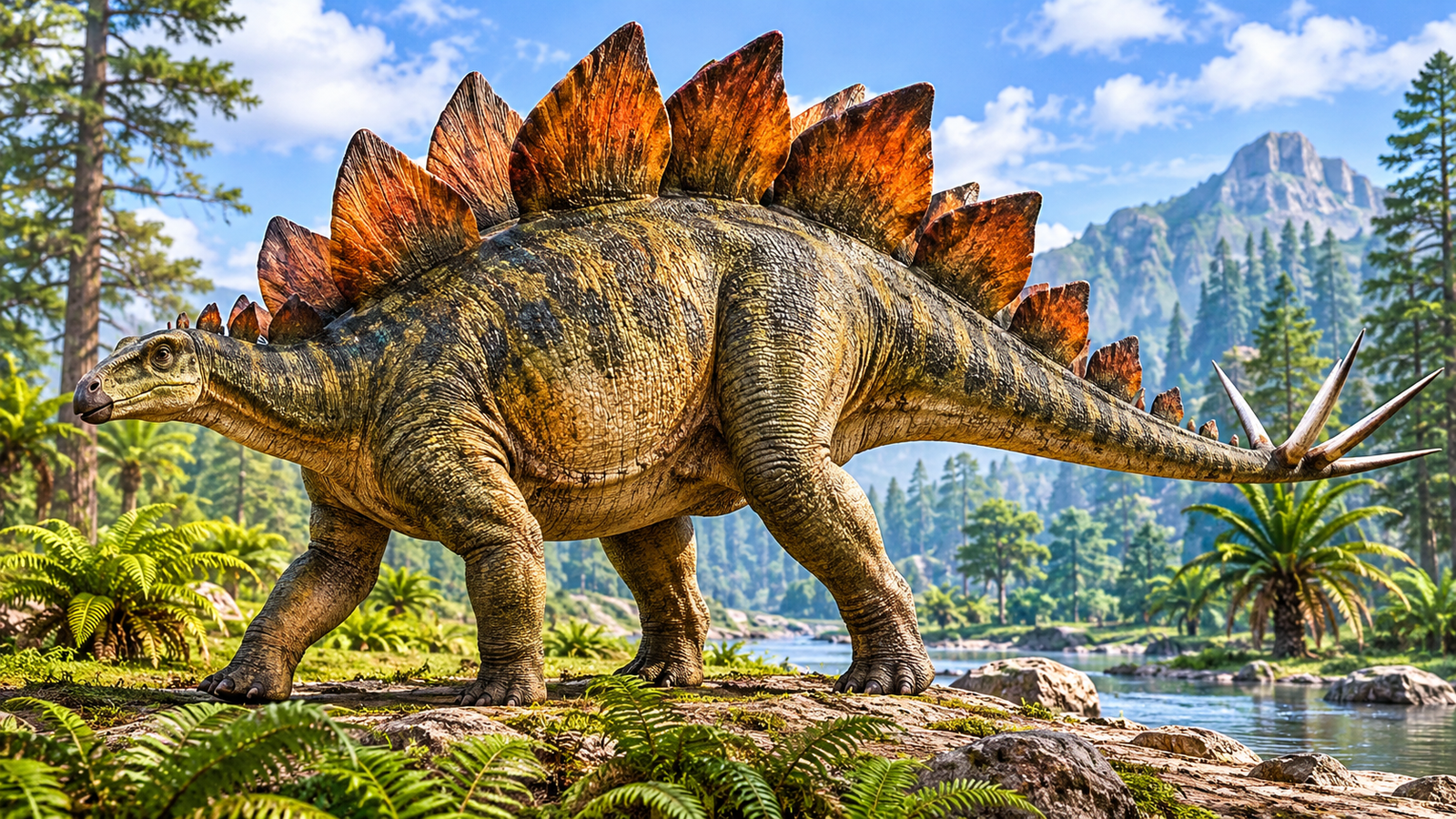
Stegosaurus had a large, heavy body supported by four strong legs. Its front legs were shorter than its hind legs, giving its back a slightly curved appearance. This body structure also meant that its head remained relatively close to the ground.
One of its most unusual features was its small head compared with the size of its body. It had a narrow mouth and relatively small teeth that helped it feed on plants.
However, the most recognizable part of its appearance was the double row of large bony plates along its back. These plates extended from the neck area toward the tail and gave the dinosaur a unique shape.
Its tail was another important feature. It contained four long, pointed spikes that may have helped protect it from dangerous predators.
The Mysterious Plates on Its Back
The large plates on Stegosaurus’s back are among the most interesting features in dinosaur history. These plates were made of bone and arranged in two alternating rows along the dinosaur’s back.
Scientists have studied these plates for many years, but their exact purpose is still debated.
One popular scientific explanation is that the plates helped regulate body temperature. Because they contained blood vessels, they may have helped absorb heat from sunlight or release excess heat into the surrounding environment.
Another possibility is that the plates were used for display. Their unusual appearance may have helped Stegosaurus attract mates, recognize other members of its species, or make itself appear larger to predators.
Some scientists believe the plates could have served multiple purposes rather than having only one function.
These structures make Stegosaurus particularly interesting because they show how dinosaurs developed unusual physical features during evolution.
The Powerful Tail Spikes of Stegosaurus
The tail of Stegosaurus was not just an ordinary body part. It carried four long, pointed spikes that were probably used as defensive weapons.
This arrangement of tail spikes is commonly known as a thagomizer.
When threatened by predators, Stegosaurus may have swung its tail from side to side to strike an approaching attacker. The sharp spikes could potentially cause serious injuries, making it dangerous for predators to get too close.
Scientists have also discovered fossil evidence suggesting that Stegosaurus could injure attacking dinosaurs. Some Allosaurus fossils show injuries that may have been caused by Stegosaurus tail spikes.
This suggests that even large meat-eating dinosaurs had to be careful when attacking an adult Stegosaurus.
Its tail was probably one of its most effective survival features.
What Did Stegosaurus Eat?
Stegosaurus was a herbivore, meaning it survived by eating plants rather than hunting other animals.
Its diet probably included ferns, cycads, mosses, and other types of prehistoric vegetation. It mainly fed on low-growing plants because its short neck and small head made reaching high branches difficult.
Unlike modern cows and other grazing animals, Stegosaurus did not have advanced chewing teeth for grinding tough plants. Its teeth were relatively small and designed for basic processing of vegetation.
Scientists believe it may have swallowed plant material with limited chewing and relied on its digestive system to break it down.
Because plants were widely available in its Jurassic environment, Stegosaurus likely spent a considerable amount of time searching for food.
How Big Was Stegosaurus?
Stegosaurus was a large dinosaur, although it was smaller than many long-necked dinosaurs that lived during the same period.
An adult Stegosaurus could reach approximately 9 metres (30 feet) in length and weigh around 3 to 5 metric tons. Exact estimates vary depending on the fossil specimen and species being studied.
Its heavy body was supported by four powerful legs, with the hind legs being longer than the front legs.
Despite its impressive size, its head was surprisingly small. This unusual body proportion has made Stegosaurus a popular subject of scientific research.
Its large body and defensive tail made it a difficult animal for many predators to attack.
Did Stegosaurus Really Have Two Brains?
One of the most famous stories about Stegosaurus is that it had two brains.
This idea became popular because scientists discovered that its brain was extremely small compared with its body size. They also identified a large cavity in the hip region of its spinal canal.
Early researchers suggested that this space might have contained a second brain that helped control the dinosaur’s hind legs and tail.
However, modern scientific research does not support the idea that Stegosaurus had two brains.
The cavity was more likely associated with an enlargement of the spinal cord or other nervous system structures.
Like other dinosaurs, Stegosaurus had one brain. The two-brain story remains a popular misconception rather than an established scientific fact.
How Did Stegosaurus Defend Itself From Predators?
Stegosaurus lived alongside dangerous meat-eating dinosaurs, particularly Allosaurus. These predators could attack large herbivorous animals, so Stegosaurus needed effective ways to protect itself.
Its strongest defensive feature was its spiked tail. When threatened, it could turn its body toward an attacker and swing its tail to strike.
The sharp spikes may have caused serious injuries to predators, discouraging them from continuing an attack.
Its large body also provided some protection, while the plates along its back may have made it look more intimidating.
Although scientists are still investigating the exact defensive role of its plates, the tail spikes are widely considered important weapons for protection.
Interesting Facts About Stegosaurus
Here are some fascinating facts about this famous Jurassic dinosaur:
- Stegosaurus lived approximately 155 to 150 million years ago.
- Its name means “roof lizard” in Greek.
- It was a plant-eating dinosaur rather than a meat-eater.
- It had two rows of large bony plates along its back.
- Its tail carried four sharp spikes for defence.
- It walked on four legs, with longer hind legs than front legs.
- Its brain was surprisingly small compared with its body.
- It lived alongside famous dinosaurs such as Allosaurus and Diplodocus.
- Many important Stegosaurus fossils have been discovered in North America.
- Scientists still debate the exact purpose of its back plates.
How Was Stegosaurus Discovered?
The first Stegosaurus fossils were discovered in the United States during the 19th century. The dinosaur was officially named by American paleontologist Othniel Charles Marsh in 1877.
At first, scientists had limited information about its appearance and lifestyle. However, additional fossil discoveries gradually helped researchers understand its unusual body structure.
As more specimens were studied, scientists learned about its plates, tail spikes, teeth, legs, and feeding habits.
One well-known species is Stegosaurus stenops, which is represented by relatively complete fossil specimens. These discoveries have helped paleontologists understand how this dinosaur looked and moved.
Today, Stegosaurus fossils remain valuable for studying dinosaur evolution and the prehistoric ecosystems of the Jurassic Period.
Why Is Stegosaurus So Popular?
Stegosaurus remains one of the most popular dinosaurs because of its distinctive appearance and unusual features.
Its large plates, powerful tail spikes, small head, and heavy body make it easy to recognize. It frequently appears in dinosaur documentaries, educational books, museum exhibitions, movies, and children’s learning materials.
For dinosaur enthusiasts, Stegosaurus is an excellent example of how prehistoric animals developed different adaptations to survive in their environments.
Even after millions of years, its fossils continue to provide scientists with new opportunities to understand the incredible diversity of dinosaur life.
Conclusion
Stegosaurus was one of the most fascinating herbivorous dinosaurs of the Late Jurassic Period. Its unusual back plates, powerful tail spikes, and massive body made it a unique animal in prehistoric history.
Although it was a plant-eater, it had impressive defensive features that probably helped protect it from predators such as Allosaurus.
Scientists continue to study its fossils to understand the purpose of its plates, its feeding habits, and its lifestyle. From the mystery of its back plates to the famous two-brain misconception, Stegosaurus remains an important and fascinating subject in paleontology.
Its story reminds us how diverse and extraordinary dinosaur life was millions of years ago.