
Dinosaurs lived in herds, built nests, courted mates, and defended territory, and all of that requires some form of communication. But what did a dinosaur “say,” and how did it say it? We can’t hear a dinosaur call, so scientists piece the answer together from skull shapes, ear structures, feathers, crests, and what we know about the dinosaurs that are still alive today: birds. The picture that emerges is quite different from the roaring monsters in movies.
Why Would Dinosaurs Need to Communicate?
Many dinosaurs were social animals. Fossil trackways show groups of the same species walking together, and some sites preserve large nesting colonies. Animals that live in groups or care for young typically need ways to attract mates, warn of danger, keep the group together, and settle disputes. Dinosaurs almost certainly used a mix of sight and sound, much like modern birds and reptiles.
Visual Communication: Dinosaurs Were Built to Be Seen
Some of the strongest evidence for dinosaur communication is visual. Many dinosaurs carried elaborate crests, horns, frills, and plumes that seem to have little use except for display.
Crests, Horns, and Frills
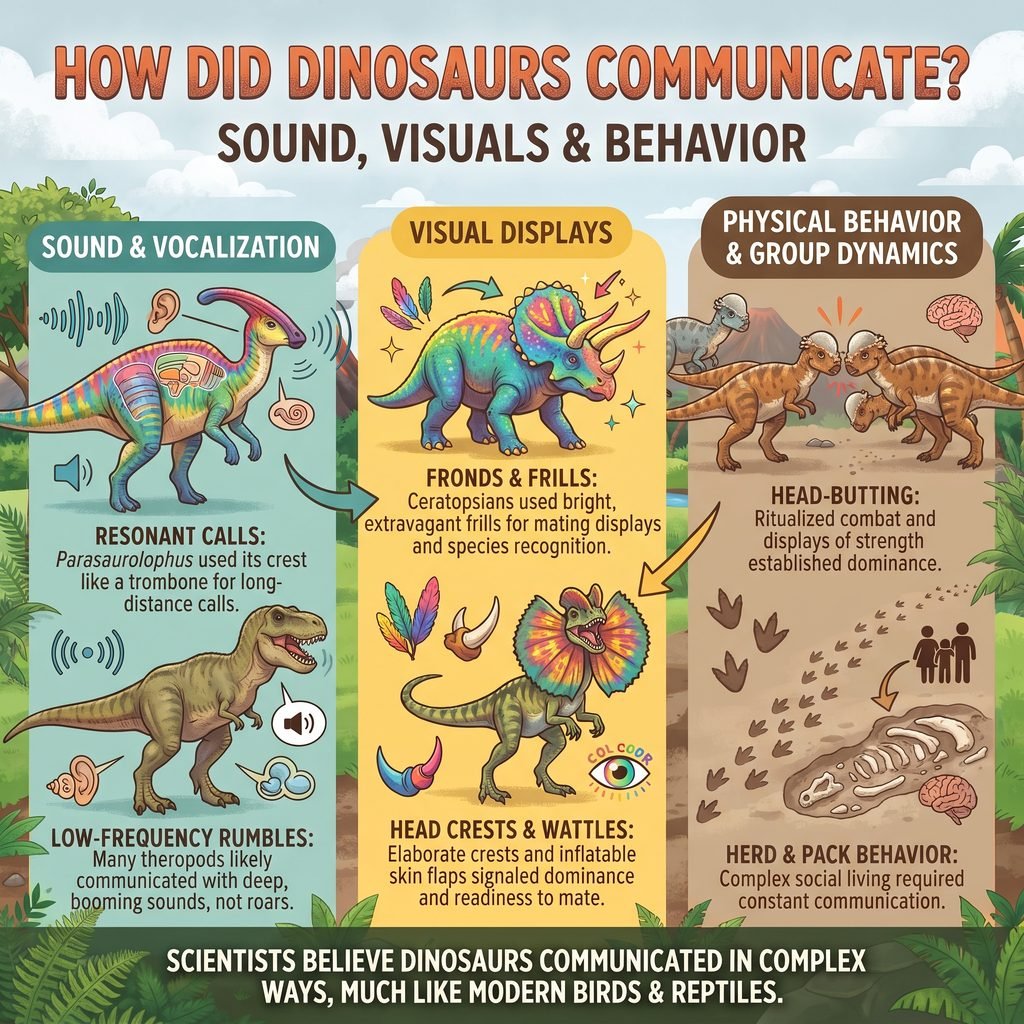
The head ornaments of dinosaurs such as Triceratops, Parasaurolophus, and the crested theropod Dilophosaurus were probably used to recognize other members of the same species, to impress mates, or to signal status to rivals. This is similar to how antlers, crests, and brightly colored displays work in animals today. Exactly which function mattered most for each species is still debated, and several uses were likely combined.
Feathers and Color
Feathered dinosaurs gave visual signaling another dimension. Microscopic pigment structures called melanosomes have been found in some fossil feathers, which has allowed scientists to reconstruct color patterns in a few species. For example, Sinosauropteryx is thought to have had a banded tail, and Anchiornis a striking pattern of dark body feathers with white wing markings and a reddish crest. Fanlike feathers on the tails and arms of dinosaurs such as Caudipteryx and its relatives may have been used in display, as in many living birds.
Sound: What Did Dinosaurs Sound Like?
This is the hardest question, because sound leaves no direct fossil record. Even so, researchers have some clues.
Not Roars, but Booms and Coos
Movies give dinosaurs lion-like roars, but there is little reason to think that is accurate. Birds and crocodilians, the dinosaurs’ closest living relatives, do not roar. Many make sounds with their mouths closed, such as the deep booming of a crocodile or the cooing of a dove. A study of how birds and reptiles produce sound suggested that this type of closed-mouth vocalization may have been common in dinosaurs, especially larger ones, producing deep, resonant booms or coos rather than roars. This is a well-supported hypothesis but not a proven fact.
No Bird-Style Song Box
Birds produce song using a special organ called the syrinx, which is located at the base of the windpipe. The oldest known fossil syrinx belongs to a Cretaceous bird, Vegavis, and there is no solid evidence that non-bird dinosaurs had one. They probably made sounds in other ways, such as with the larynx or by other mechanisms shared with crocodiles.
The Hollow Crest of Parasaurolophus
Parasaurolophus had a long, curved crest with hollow air passages running through it. Scientific models of these passages suggest the crest could resonate and produce low-pitched, trumpet-like or foghorn-like sounds. That could have helped individuals recognize each other or call over distance, and the crest also doubled as a visual signal. Different species and different ages seem to have had differently shaped crests, which would have changed the sound.
Could Dinosaurs Hear?
Sound is only useful if someone can hear it, and the inner ear bones of dinosaurs give hints about their hearing. In general, the length of the cochlea, the hearing organ, is linked to the range of sounds an animal can pick up. Studies of the ears of several dinosaurs, including tyrannosaurs and some plant eaters, suggest that many were most sensitive to low-frequency sounds, which fits with the idea that their calls were deep and rumbling. Hearing ability varied between groups, and some small predators may have heard higher sounds.
Sounds Beyond the Voice
Dinosaurs may have made noise in other ways too:
- Tail cracking: One controversial idea is that the whip-like tails of diplodocid sauropods could have been snapped to make a loud cracking sound. Scientists disagree on whether this really happened.
- Feather sounds: Birds can make sounds with their wings and feathers, so feathered dinosaurs may have been able to rustle or clap them in display.
- Foot stomping and head butting: Some dinosaurs may have created noise through physical contact, though evidence is limited, and ideas such as head-butting in thick-skulled dinosaurs are still debated.
Communication Between Parents and Young
Fossil nests show that some dinosaurs, such as Maiasaura, nested in groups and likely cared for their young. Parental care in animals usually involves some signaling between adults and hatchlings. Modern birds and crocodiles both use calls, as crocodile hatchlings chirp from inside the egg to prompt adults to help. It seems reasonable that some dinosaurs did something similar, although direct fossil evidence for this is lacking.
What Living Dinosaurs Can Teach Us
Birds are living dinosaurs, so their behavior offers valuable clues. Birds use song, calls, dances, colorful plumage, and elaborate displays to communicate. Crocodilians contribute a different perspective: they use deep rumbles, water-surface vibrations, and body posture. By looking at what these two groups have in common, scientists can infer what the common ancestors of all dinosaurs may have been able to do, and then compare that with the fossil evidence.
Communication Methods at a Glance
| Method | Example Dinosaurs | Evidence |
|---|---|---|
| Visual display | Triceratops, Dilophosaurus, Caudipteryx | Crests, horns, frills, and display feathers |
| Color patterns | Sinosauropteryx, Anchiornis | Melanosomes preserved in fossil feathers |
| Low-pitched calls | Parasaurolophus | Hollow crest passages; closed-mouth vocalization in relatives |
| Hearing | Tyrannosaurs and others | Inner ear structure suggests low-frequency hearing |
| Group and nest signaling | Maiasaura and herd dinosaurs | Trackways and nesting colonies |
Key Takeaways
- Dinosaurs communicated using a combination of sight and sound.
- Crests, horns, frills, and feathers were likely used for display and species recognition.
- Many dinosaurs probably made deep booms, coos, or rumbles rather than movie-style roars.
- Parasaurolophus‘s hollow crest is the best-studied example of a possible sound-making structure.
- Much of what we know comes from inference, using birds and crocodiles as living models.
Frequently Asked Questions
Did dinosaurs roar?
Probably not in the way movies show. Birds and crocodiles do not roar, and the evidence suggests many dinosaurs made deeper, closed-mouth sounds such as booms and coos.
Which dinosaur had the most interesting way of making sound?
Parasaurolophus is a top candidate, because its hollow crest could have worked like a resonating horn.
Could dinosaurs sing like birds?
Probably not. Birdsong relies on the syrinx, and there is no convincing evidence that non-bird dinosaurs had one, though feathered relatives of birds may have made more varied sounds than larger dinosaurs.
How do scientists know what colors dinosaurs were?
In some exceptionally preserved fossils, tiny pigment-carrying structures in feathers can be examined and compared with those of living birds. This has revealed color patterns in only a handful of species.
Keep exploring Dinosaur Facts & General Information with our articles How Fast Could Dinosaurs Run? and What Did Dinosaurs Eat? to learn even more about life in the prehistoric world.