
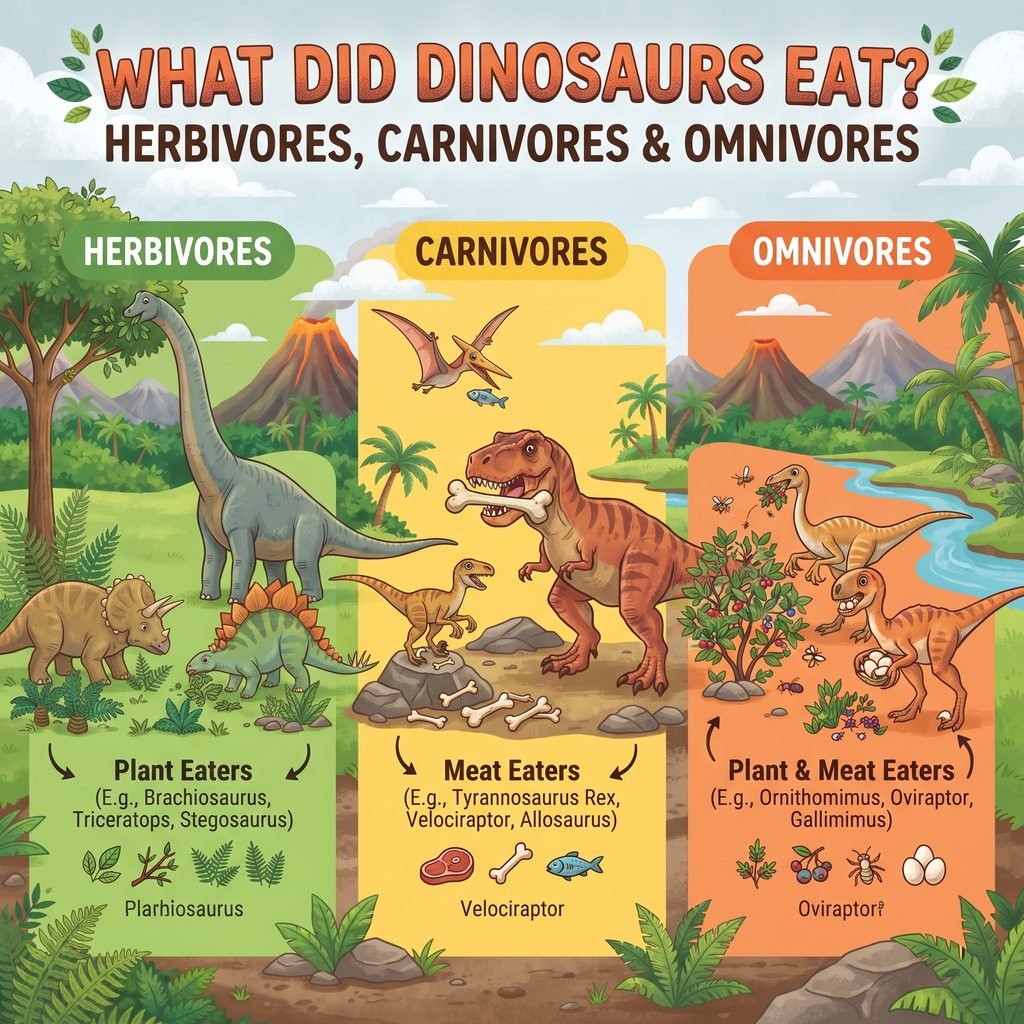
What did dinosaurs eat? The answer depends on which dinosaur you mean. Over roughly 165 million years, dinosaurs evolved into an enormous variety of forms, and their diets were just as varied. Some spent their days stripping leaves from tall trees, others hunted large prey, and many ate a mix of plants and animals. Scientists can work out what these animals ate by studying their teeth, jaws, fossilized droppings, and even the stomach contents preserved inside a few exceptional fossils.
How Do We Know What Dinosaurs Ate?
Nobody has watched a dinosaur eat, so paleontologists rely on several types of evidence:
- Teeth and jaws: Tooth shape is one of the best clues. Sharp, serrated teeth suggest meat-eating, while flat, ridged teeth suggest grinding plants.
- Coprolites (fossilized droppings): These can contain plant fragments, crushed bone, or other food remains.
- Stomach contents: A few fossils preserve their last meals, such as fish scales, small lizards, or mammals.
- Bite marks: Tooth marks on fossil bones show which predators fed on which animals.
- Tooth wear: Microscopic scratches and wear patterns on teeth reveal how tough or abrasive the food was.
- Gastroliths (stomach stones): Some dinosaurs appear to have swallowed stones, probably to help grind food, as many birds do today. How common this was, especially among the giant plant-eaters, is still debated.
Herbivores: The Plant Eaters
Most dinosaur species, and certainly most of the biggest ones, were herbivores. Plant-eating dinosaurs belonged to several very different groups, each with its own feeding style.
Sauropods: The Long-Necked Giants
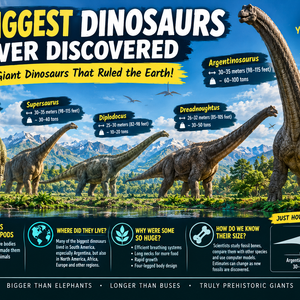
Dinosaurs like Brachiosaurus, Diplodocus, and Apatosaurus had small heads, long necks, and huge bodies. Their teeth were simple pegs or spoon-like shapes used mainly to strip foliage rather than chew it. Their long necks allowed them to reach large amounts of vegetation, perhaps high in the trees or sweeping across a wide area without moving their bodies much. The details of how they held their necks remain a topic of discussion among scientists.
Hadrosaurs: The “Duck-Billed” Dinosaurs
Hadrosaurs such as Edmontosaurus had broad, toothless beaks for snipping plants and, further back in the mouth, “dental batteries” packed with hundreds of small teeth. These worked like a grinding surface, letting hadrosaurs process tough plant material far more thoroughly than most other dinosaurs.
Ceratopsians: The Horned Dinosaurs
Triceratops and its relatives had parrot-like beaks for cutting vegetation and rows of teeth that sheared plants like scissors. This suited them for tough, low-growing plants.
Stegosaurs and Ankylosaurs: The Armored Plant Eaters
Plated and armored dinosaurs such as Stegosaurus and Ankylosaurus held their heads relatively low and are generally thought to have fed on low-growing plants. Their small teeth were not built for heavy chewing, so they likely ate softer vegetation.
What Plants Did They Eat?
The menu changed over time. In the early part of the dinosaur age, plant life was dominated by ferns, cycads, horsetails, and conifers such as monkey-puzzle-type trees. Flowering plants appeared later, during the Cretaceous Period, and gradually became more common. Grasses, which we associate with lawns and grasslands, were rare or absent for most of the dinosaur era. Fossilized dinosaur droppings from the very end of the Cretaceous have even preserved microscopic grass particles, but grasslands as we know them came long after the dinosaurs.
Carnivores: The Meat Eaters
Carnivorous dinosaurs, mostly the theropods, ranged from tiny hunters to some of the largest predators ever to walk on land.
Tyrannosaurs and Other Large Predators
Tyrannosaurus rex had massive jaws and thick, strong teeth designed to crush bone. Bite marks on fossils of horned and duck-billed dinosaurs show that it attacked large prey, and fossilized droppings containing crushed bone show that it really did eat bone. Whether T. rex mostly hunted or scavenged is a long-running debate, and the most likely answer is that it did both, as many modern predators do. Allosaurus, in contrast, had a lighter skull and blade-like teeth for slicing.
Small Raptors and Feathered Hunters
Smaller predators like Velociraptor and Deinonychus probably hunted smaller animals. Rare preserved stomach contents from small feathered dinosaurs such as Sinosauropteryx and Microraptor include lizards, mammals, birds, and fish, showing that even tiny dinosaurs were opportunistic hunters.
Fish Eaters
Some theropods specialized in fish. Baryonyx, with its long, crocodile-like snout and conical teeth, is a classic example. A fossil of this dinosaur preserved fish scales in its stomach region, along with remains of a young plant-eating dinosaur, so it was probably not strictly a fish-only eater. Spinosaurus had a similar snout and is also widely thought to have eaten fish, though how much time it spent in the water is still debated.
Omnivores: Eating Both Plants and Animals
Not every dinosaur fit neatly into the “plant eater” or “meat eater” box. Some groups probably ate whatever was available.
- Ornithomimids (“ostrich mimics”): Toothless beaks and a mix of features suggest some may have eaten plants, insects, and small animals.
- Oviraptorosaurs: These beaked dinosaurs, such as Caudipteryx, are thought to have had varied diets, and Caudipteryx specimens have been found with stomach stones.
- Therizinosaurs: Despite being related to meat-eating theropods, these long-clawed, pot-bellied dinosaurs seem to have evolved into plant eaters.
The fact that predator relatives gave rise to plant eaters is a reminder that diet in dinosaurs changed over time, and that the family tree does not always predict what an animal ate.
Quick Comparison: Dinosaur Diets at a Glance
| Diet Type | Example Dinosaurs | Key Clues |
|---|---|---|
| Herbivore | Diplodocus, Triceratops, Edmontosaurus, Stegosaurus | Peg-like, leaf-shaped, or grinding teeth; beaks; barrel-shaped bodies |
| Carnivore | Tyrannosaurus, Allosaurus, Velociraptor | Sharp, serrated or bone-crushing teeth; powerful jaws; bite marks on bones |
| Piscivore (fish eater) | Baryonyx, Spinosaurus | Long, narrow snouts; conical teeth; fish remains |
| Omnivore | Ornithomimids, Oviraptorosaurs | Beaks, few or no teeth, stomach stones, mixed features |
Did Dinosaurs Compete for Food?
Dinosaur ecosystems were complex. Different plant eaters likely fed at different heights and on different plants, reducing competition. Large and small predators also targeted different prey. This division of resources helped many dinosaur species live together in the same environment, much like the animals of an African savanna today.
Key Takeaways
- Dinosaur diets varied widely, so there is no single answer to what dinosaurs ate.
- Most dinosaurs, including the biggest, were plant eaters.
- Teeth, jaws, coprolites, bite marks, and preserved stomach contents are the main evidence for diet.
- Carnivores ranged from small hunters to huge, bone-crushing predators like T. rex.
- Some dinosaurs were omnivores, and diets changed over time in some dinosaur families.
Frequently Asked Questions
What did most dinosaurs eat?
Most dinosaur species were herbivores, feeding on ferns, cycads, conifers, and, later in the Cretaceous, flowering plants.
Did T. rex eat plants?
No evidence suggests that T. rex ate plants. It was a carnivore, with bone-crushing jaws and teeth built for tearing through large prey.
Did dinosaurs eat grass?
Grasses existed near the end of the dinosaur age, and a few dinosaurs did eat them, but grass was not a major part of most dinosaur diets, and grasslands as we know them had not yet spread widely.
Which dinosaur ate fish?
Baryonyx and Spinosaurus are the best-known fish-eating dinosaurs, based on their crocodile-like snouts and, in the case of Baryonyx, fish remains found with the fossil.
Could a dinosaur’s diet change over its lifetime?
It is possible that some young dinosaurs ate different food from adults, as many living animals do, but this is hard to confirm and still being studied.
Want to keep exploring? Check out our other articles in Dinosaur Facts & General Information, including How Fast Could Dinosaurs Run?, to learn more about life in the prehistoric world.

This Post Has One Comment