Velociraptor is one of the most famous dinosaurs on the planet, thanks mostly to the movies. But the real animal was very different from the man-sized, scaly monster on screen. In this guide, you’ll learn the true Velociraptor facts: how big it was, what it looked like, where it lived, and how it hunted.
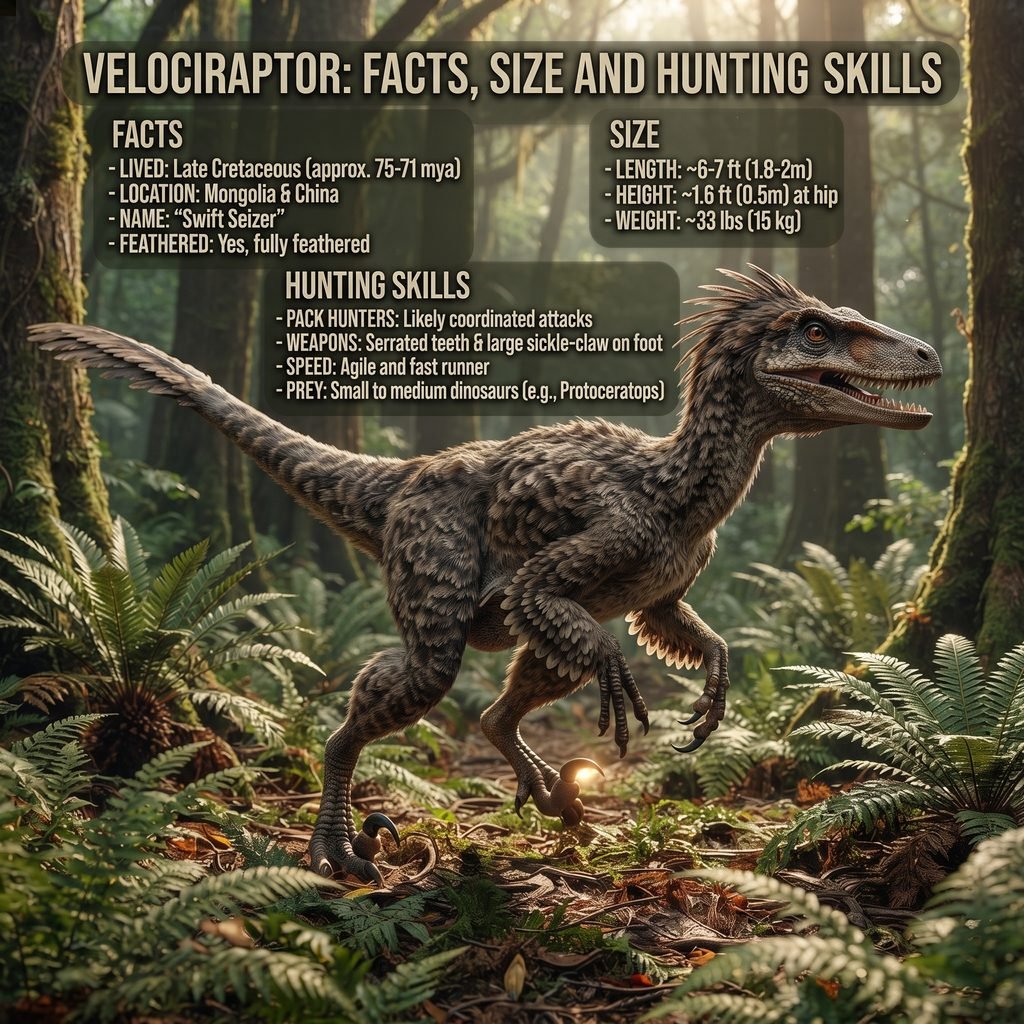
Quick Velociraptor Facts at a Glance
| Feature | Details |
|---|---|
| Scientific name | Velociraptor mongoliensis (type species) |
| Name meaning | “Swift thief” (sometimes translated “swift seizer”) |
| Pronunciation | veh-LOSS-ih-RAP-tor |
| Group | Dromaeosauridae (“raptor” dinosaurs), a type of theropod |
| Time period | Late Cretaceous, about 75 to 71 million years ago |
| Location | Mongolia and Inner Mongolia (China), Asia |
| Length | Up to about 2 meters (6.5 feet) |
| Hip height | About 0.5 meters (1.6 feet) |
| Weight | Up to roughly 15 kilograms (33 pounds) |
| Diet | Carnivore |
| Special features | Feathered forearms, sickle-shaped toe claw, long stiff tail |
| Named by | Henry Fairfield Osborn, 1924 |
What Does “Velociraptor” Mean?
The name Velociraptor comes from Latin words meaning “swift” and “robber” or “thief.” It was given to the animal in 1924 by Henry Fairfield Osborn, then president of the American Museum of Natural History in New York, to reflect its light build and predatory lifestyle.
How Big Was Velociraptor?
This is the most common surprise: Velociraptor was about the size of a large turkey or a medium-sized dog, not a human-sized predator. Adults were roughly 2 meters long including the tail, stood about half a meter tall at the hips, and weighed up to around 15 kilograms.
The movie “Jurassic Park” showed raptors much larger than the real animal. In fact, the film versions were closely modeled on a larger relative called Deinonychus, which grew to around 3 meters in length.
Movie Velociraptor vs. Real Velociraptor
| Trait | In the Movies | In Real Life |
|---|---|---|
| Size | Human-sized, around 2 meters tall | Turkey-to-dog sized, about 0.5 meters tall at the hip |
| Skin | Bare, scaly skin | Feathered, with quill knobs on the forearm |
| Model | Resembles Deinonychus | Smaller, with a longer, flatter snout |
| Behavior | Clever pack hunters opening doors | Active predator; group hunting is unproven |
| Home | Tropical island | Dry, desert-like environment in Asia |
Did Velociraptor Have Feathers?
Yes. In 2007, a team led by Alan Turner, Peter Makovicky, and Mark Norell reported quill knobs on a Velociraptor forearm bone from Mongolia. Quill knobs are small bumps where large feathers anchor to the bone, and they are found in many modern birds. Their presence is strong evidence that Velociraptor carried feathers on its arms. You can read more in this National Geographic article on the discovery.
Velociraptor could not fly. It was too heavy, and its arms were too short for that. Scientists suggest the feathers may have been used for display to mates or rivals, warmth, covering nests, or balance while running. Its smaller ancestors may well have been able to glide or fly, with Velociraptor keeping the feathers for other purposes.
Where and When Did Velociraptor Live?
Velociraptor lived in Asia during the Late Cretaceous, roughly 75 to 71 million years ago. Fossils of the type species, V. mongoliensis, come mainly from the Djadochta Formation in Mongolia’s Gobi Desert. A second species, V. osmolskae, was named in 2008 from skull material found in the Bayan Mandahu Formation of Inner Mongolia, China.
The environment was dry and desert-like, with sand dunes, seasonal streams, and scattered oases. Velociraptor shared this landscape with other dinosaurs such as the horned Protoceratops and the armored Pinacosaurus.
Body Features That Made Velociraptor a Predator
- Sickle-shaped claw: On the second toe of each foot was a large, curved claw, roughly 6 to 7 centimeters long. It was held off the ground when walking so it stayed sharp.
- Grasping hands: Its three-fingered hands carried strongly curved claws for gripping prey.
- Long, narrow skull: The snout was elongated and lined with serrated teeth, ideal for slicing flesh.
- Stiff, bony tail: Bony rods along the tail kept it rigid, helping Velociraptor balance and turn quickly while running.
- Light, hollow bones: Like birds, it had a lightweight skeleton suited for agility.
- Relatively large brain: For its body size, its brain was larger than that of many dinosaurs, which suggests sharp senses.
Velociraptor’s Hunting Skills
What Did Velociraptor Eat?
Velociraptor was a carnivore. Its likely prey included small dinosaurs, lizards, and mammals of its time. Like many predators, it may have also scavenged carcasses when the opportunity arose. Its small size meant that it likely avoided large, heavily built prey.
The “Fighting Dinosaurs” Fossil
The best evidence for Velociraptor’s hunting behavior is the famous “Fighting Dinosaurs” fossil, discovered in Mongolia in 1971. It shows a Velociraptor locked in combat with a Protoceratops. The predator’s hand grips the herbivore’s frill while a foot claw presses toward the throat area, while the Protoceratops’ beak clamps the raptor’s arm. They appear to have been buried together, probably by a collapsing sand dune or sandstorm, in the middle of the struggle.
How Was the Claw Used?
Older illustrations often show raptors slashing open prey with the toe claw like a blade. Modern research suggests the claw was more likely used for gripping and pinning prey. Some scientists have compared Velociraptor’s likely hunting style to that of modern birds of prey, which grasp their victims with their feet while they feed.
Did Velociraptors Hunt in Packs?
This idea comes largely from movies. In reality, there is no firm fossil evidence that Velociraptor hunted in coordinated packs. Researchers have debated pack hunting for related dromaeosaurids, but the evidence is limited and disputed. It is safest to say that Velociraptor was an active predator that may have hunted alone.
How Fast Was Velociraptor?
Velociraptor was lightly built, with long hind legs, and was probably quick and agile. Exact running speeds are hard to determine from fossils, so figures you may see online are estimates rather than facts.
Common Velociraptor Myths
| Myth | Fact |
|---|---|
| Velociraptors were as tall as humans. | They stood only about half a meter tall at the hip. |
| They were scaly like lizards. | Quill knobs show they had feathers. |
| They could open doors. | Their hands could grasp prey, but there is no evidence of such complex dexterity. |
| They always hunted in packs. | Pack hunting is unproven. |
| They lived alongside T. rex. | T. rex lived in North America about 68 to 66 million years ago, on a different continent and at a later time. |
How Was Velociraptor Discovered?
On 11 August 1923, fossil collector Peter Kaisen found the first known Velociraptor specimen during an American Museum of Natural History expedition to the Flaming Cliffs (Bayn Dzak) in the Gobi Desert. It was a crushed but complete skull together with a toe claw. Osborn formally named the genus the following year. Later expeditions in 1990 and afterwards recovered several well-preserved skeletons, making Velociraptor one of the best-known dromaeosaurids. For more background, see the Velociraptor article on Wikipedia and the Live Science Velociraptor fact sheet.
Frequently Asked Questions
How big was a Velociraptor?
About 2 meters (6.5 feet) long, 0.5 meters (1.6 feet) tall at the hip, and up to about 15 kilograms (33 pounds) in weight.
Did Velociraptor have feathers?
Yes. Quill knobs on a forearm bone found in Mongolia confirm that it had feathers.
Could Velociraptor fly?
No. It had feathers but was flightless.
Was Velociraptor smart?
It had a relatively large brain for its size, but its intelligence is often exaggerated in films. There is no evidence that it was as smart as portrayed in movies.
When did Velociraptor live?
About 75 to 71 million years ago, during the Late Cretaceous period.
Is a Velociraptor related to birds?
Yes. Velociraptor belongs to the dromaeosaurids, a group of feathered theropods closely related to the ancestors of modern birds. If you’re curious about this link, read our article on whether dinosaurs were warm-blooded or cold-blooded.
Final Thoughts
The real Velociraptor may be smaller than its movie version, but it was no less fascinating: a feathered, fast, sharp-clawed predator that roamed the deserts of Late Cretaceous Asia. Thanks to fossils like the “Fighting Dinosaurs” and the discovery of quill knobs, we now have a far more accurate picture of this “swift thief.” To learn how fossils like these are found and studied, check out our guide on how scientists discover and identify dinosaurs.