
For more than a century, dinosaurs were pictured as slow, sluggish giants, basically oversized lizards dragging their tails through prehistoric swamps. Today, that image has been almost completely overturned. But the question still pops up in classrooms, museums, and documentaries: were dinosaurs warm-blooded or cold-blooded?
The short answer: it’s not an either/or question. Many dinosaurs appear to have had a metabolism somewhere between a modern lizard and a modern bird, and the answer likely varied from one species to another. Let’s dig into why.
What Do “Warm-Blooded” and “Cold-Blooded” Actually Mean?
These everyday terms are a bit misleading, so scientists prefer more precise words:
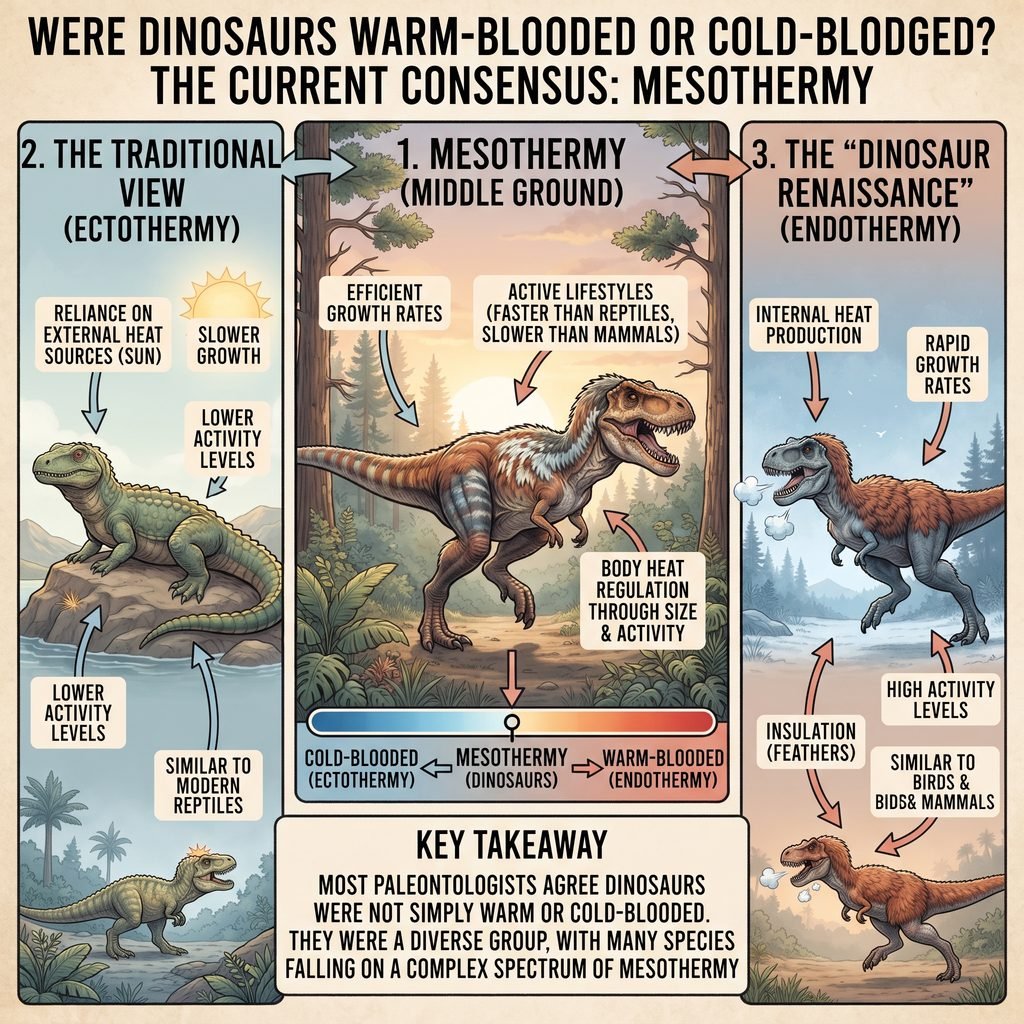
- Endothermy (“warm-blooded”): The animal produces most of its body heat internally through a fast metabolism. Birds and mammals are endotherms. They keep a steady, high body temperature but need lots of food to fuel it.
- Ectothermy (“cold-blooded”): The animal relies mostly on the environment, such as sunlight or warm rocks, to regulate its temperature. Lizards, snakes, and crocodiles are ectotherms. They need far less food but are less active in cool conditions.
- Homeothermy vs. poikilothermy: Homeotherms keep a stable body temperature, while poikilotherms let it fluctuate. A large ectotherm can still be a homeotherm simply because of its size.
Real animals don’t always fit neatly into these boxes, and dinosaurs are a perfect example.
The Old View: Dinosaurs as Cold-Blooded Reptiles
When dinosaurs were first described in the 1800s, scientists compared them to the reptiles they knew: lizards and crocodiles. The name “dinosaur,” coined by Richard Owen in 1842, even suggests “terrible lizard.” So it seemed natural to assume dinosaurs were cold-blooded, slow, and sluggish.
That assumption started to crumble in the late 1960s and 1970s, during what is often called the “Dinosaur Renaissance.” Paleontologists such as John Ostrom and Robert Bakker argued that animals like Deinonychus looked fast, agile, and active, more like a bird than a lizard.
Evidence That Dinosaurs Were Warm-Blooded (or Close to It)
1. Birds Are Living Dinosaurs
This is the biggest clue. Modern birds evolved from small, feathered theropod dinosaurs, and birds are fully endothermic. Because birds and crocodiles are the closest living relatives of non-bird dinosaurs, scientists can look at both to guess what the common ancestor was like. Some of the fast-living traits we see in birds probably had deep roots in the dinosaur family tree.
2. Feathers and Insulation
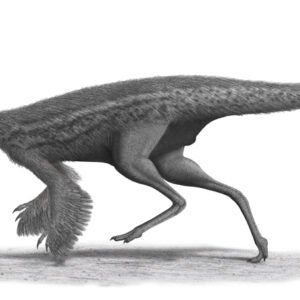
Fossils from China and elsewhere have revealed many dinosaurs covered in fuzzy filaments or true feathers, including Sinosauropteryx, Yutyrannus, and Microraptor. Insulation is mainly useful for animals that produce their own body heat and need to keep it. Its presence in so many dinosaurs hints at an elevated metabolism.
3. Bone Structure and Growth Rates
When paleontologists slice thin sections of dinosaur bone, they often find a tissue type called fibrolamellar bone, which is full of blood vessels and typically forms during fast growth. Many dinosaurs appear to have grown quickly, reaching massive sizes in a matter of years or decades. That’s much more typical of warm-blooded animals than of most modern reptiles.
4. Living in Cold Places
Dinosaur fossils have been found in polar regions, including northern Alaska and southern Australia, areas that were cool and had long, dark winters even in the warm Mesozoic world. Dinosaurs living there may have relied on internal heat production, insulation, or both to survive.
5. Posture and Activity Levels
Dinosaurs walked with their legs held directly beneath their bodies, unlike the sprawling gait of lizards. This upright posture is linked to efficient, sustained movement. Trackways also show some dinosaurs moving at a good pace, suggesting active lifestyles.
6. Efficient Breathing
Theropods and sauropods had bones with air-filled spaces, evidence of a bird-like system of air sacs. This type of breathing is very efficient at delivering oxygen, which supports a high-energy lifestyle.
7. Chemical Clues in Fossils
Some of the most exciting modern evidence comes from chemistry. Studies of oxygen isotopes and “clumped isotopes” in dinosaur teeth and eggshell have suggested that some large dinosaurs, including sauropods, maintained body temperatures similar to or higher than those of many mammals. More recently, researchers have measured chemical byproducts of metabolism preserved in fossil bone to estimate how fast different dinosaurs burned energy.
Evidence for Cold-Blooded or Lower Metabolisms
Not every clue points to a fully bird-like metabolism, and good science means looking at both sides:
- Growth rings: Some dinosaur bones show lines of arrested growth, similar to tree rings, which are also seen in modern reptiles. This suggests that growth sometimes slowed or paused, perhaps seasonally.
- Missing nasal structures: Mammals and birds have tiny, scroll-like bones in the nose (respiratory turbinates) that help recycle heat and moisture during fast, constant breathing. Dinosaurs appear to have lacked these structures, which some scientists take as a sign of a lower resting metabolism.
- Food requirements: A warm-blooded predator needs far more prey than a cold-blooded one. Some researchers have argued that predator-to-prey ratios in dinosaur ecosystems look more like those of reptiles than mammals.
- Isotope and metabolism studies: Recent research suggests that metabolic rates varied between dinosaur groups, and not all of them were equally fast-burning.
The Modern Answer: Something In Between
Many scientists now think dinosaurs were neither classic “cold-blooded” reptiles nor fully “warm-blooded” mammals. Instead, they may have been mesotherms, animals with a metabolism and temperature control that falls between the two extremes. Think of a living example like some large, active fish such as tuna or lamnid sharks, or even certain mammals with low metabolic rates.
The picture also likely differed depending on the dinosaur:
- Small, feathered theropods (like Velociraptor and its relatives) were probably the most bird-like, with high metabolic rates.
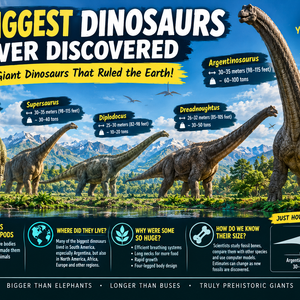
- Giant sauropods such as Brachiosaurus may have relied partly on sheer size to stay warm. A body that big loses heat very slowly, a trait called gigantothermy.
- Plant-eating ornithischians, like Triceratops and Stegosaurus, may have had lower metabolic rates than some of their meat-eating cousins, according to some recent chemical studies.
In other words, “dinosaur metabolism” was probably a spectrum, and it may have shifted over millions of years of evolution.
Why Does This Matter?
Understanding dinosaur body temperature helps scientists answer some big questions: how fast dinosaurs grew, how much they ate, how active they were, how they survived in cold climates, and how birds eventually came to be. It also changes how we imagine them. These weren’t clumsy, sluggish monsters but dynamic animals in a complex, living world.
Quick Summary
- “Warm-blooded” and “cold-blooded” are simplified terms; scientists use endotherm and ectotherm.
- Early scientists assumed dinosaurs were cold-blooded like lizards.
- Evidence from birds, feathers, bone growth, polar fossils, and chemistry points toward higher metabolisms.
- Some evidence, like growth rings and missing nasal turbinates, suggests dinosaurs weren’t identical to birds or mammals.
- Many experts favor an in-between (mesothermic) metabolism, which varied between species.
Frequently Asked Questions
Were dinosaurs warm-blooded?
Many dinosaurs, especially feathered theropods, likely had fast, bird-like metabolisms. But the evidence suggests a range of metabolic rates across different groups.
Were any dinosaurs cold-blooded?
No dinosaur was necessarily “cold-blooded” in the way a modern lizard is. Some may have had lower metabolic rates than others, but most evidence points to something more active than a typical reptile.
Are birds warm-blooded dinosaurs?
Yes. Birds are a living group of theropod dinosaurs, and they are fully warm-blooded.
How do scientists know what dinosaurs’ body temperatures were?
They study fossil bone structure, growth patterns, chemical signatures in teeth and eggshell, anatomical features like air sacs, and comparisons with living birds and reptiles.
Final Thoughts
So, were dinosaurs warm-blooded or cold-blooded? The most accurate answer is that they were a bit of both, and a bit of something new. Dinosaurs lived by their own rules, and as new fossils and techniques come to light, our understanding keeps evolving. One thing is certain: dinosaurs were far more energetic and fascinating than their “terrible lizard” reputation suggests.