T. Rex: Facts, Size, Diet and Hunting Behavior
When people hear the word T. Rex, they usually imagine a giant dinosaur with enormous jaws, sharp teeth, and a powerful roar. Tyrannosaurus rex is one of the most famous dinosaurs ever discovered, and it has become a symbol of the prehistoric world.
But what was T. rex really like? How big was it? What did it eat? And did it really hunt like the giant predator shown in movies?
In this article, we will explore the fascinating world of Tyrannosaurus rex, including its size, diet, physical features, hunting behavior, and the evidence scientists use to understand this incredible dinosaur.
🦖 What Was T. Rex?
Tyrannosaurus rex, commonly called T. rex, was a large theropod dinosaur that lived during the Late Cretaceous Period, roughly 68 to 66 million years ago.
Its fossils have mainly been discovered in western North America, including areas that are now part of the United States and Canada.
The name Tyrannosaurus rex means “tyrant lizard king.” It was given this name because of the dinosaur’s enormous skull, powerful jaws, and impressive size.
T. rex belonged to a group of theropod dinosaurs that included many meat-eating species.
📏 How Big Was T. Rex?
T. rex was one of the largest known land predators.
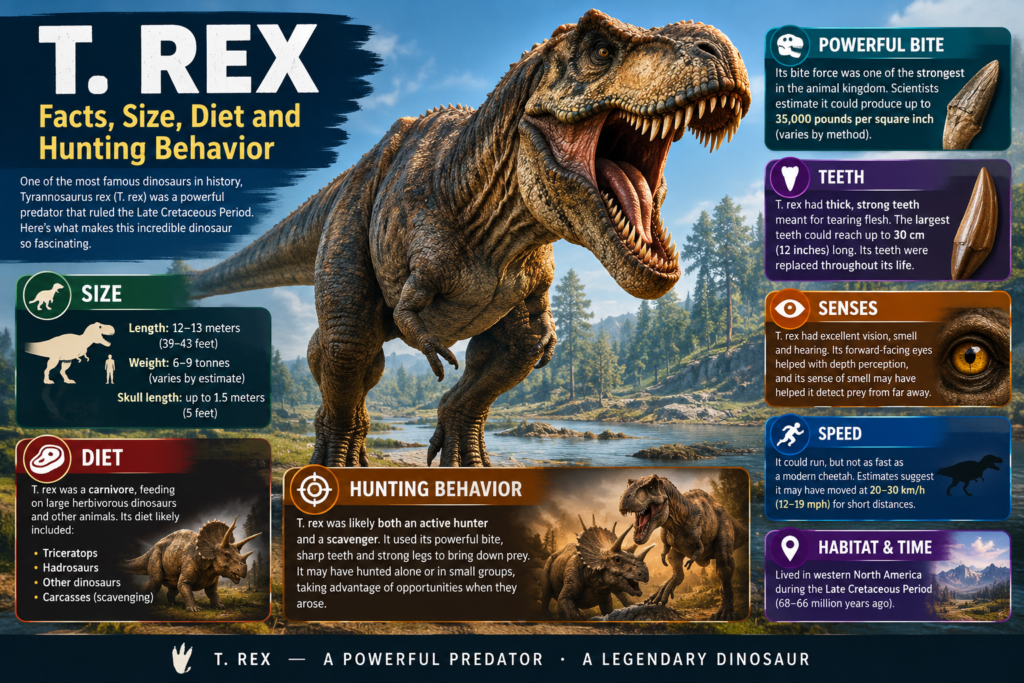
Adult individuals could reach approximately 12–13 meters (39–43 feet) in length. Their weight estimates vary, but large individuals may have weighed several tonnes.
Its massive head was one of its most impressive features. The skull could reach around 1.5 meters (5 feet) in length in very large individuals.
Despite its huge body, T. rex had relatively small arms with only two functional clawed fingers.
Its small arms may look strange compared with its enormous body, but they were not the feature that made T. rex such a successful predator.
Its true weapons were its jaws, teeth, strong legs, and powerful senses.
🦷 T. Rex Had Huge Teeth
One of the most recognizable features of T. rex was its teeth.
Its teeth were thick, strong, and shaped for dealing with large pieces of flesh. Some of the largest teeth could reach around 30 centimeters (12 inches) when measured along the curve.
Unlike the thin teeth of some predators, T. rex had robust teeth capable of withstanding significant forces.
Its teeth could also be replaced throughout its life. If a tooth was damaged or lost, another could eventually take its place.
💪 How Powerful Was the T. Rex Bite?
T. rex had an exceptionally powerful bite.
Scientists have used fossil skulls, jaw muscles, tooth structure, and computer models to estimate the forces produced by its jaws. Estimates vary depending on the method used, but its bite was powerful enough to crush and damage bones.
This ability was particularly important because T. rex was capable of consuming large prey.
Its jaws were not simply designed to slice meat. Its strong teeth and skull allowed it to apply enormous forces while feeding.
🍖 What Did T. Rex Eat?
T. rex was a carnivore, meaning its diet consisted primarily of other animals.
Potential prey included large herbivorous dinosaurs such as:
- Triceratops
- Hadrosaurs
- Other horned dinosaurs
- Smaller dinosaurs
- Carcasses of large animals
Scientists have found fossil evidence that provides clues about its diet.
For example, some fossils preserve T. rex teeth or bite marks associated with other dinosaur bones. These discoveries help researchers understand how the animal fed.
🦴 Did T. Rex Hunt or Scavenge?
For many years, scientists debated whether T. rex was primarily an active hunter or a scavenger.
Today, evidence suggests that T. rex was likely capable of both hunting and scavenging.
Like modern predators, it probably took advantage of opportunities to obtain food rather than following one strict feeding strategy.
Evidence supporting active hunting includes the anatomy of its body, strong legs, excellent senses, and fossil discoveries involving injuries that suggest interactions between T. rex and living prey.
At the same time, a huge predator would probably not ignore an easily available carcass.
So T. rex may have been both an active predator and an opportunistic scavenger.
🏃 Could T. Rex Run Fast?
T. rex had powerful hind legs and a large muscular body, but exactly how fast it could move is still debated.
Older estimates sometimes suggested extremely high speeds. More recent biomechanical research has generally produced more cautious estimates.
Because T. rex was so large, falling while running at high speed could have caused serious injuries.
Scientists therefore continue to investigate how T. rex moved by studying its bones, muscles, joints, balance, and body proportions.
Rather than imagining it sprinting like a modern cheetah, it is more accurate to think of T. rex as a large, powerful terrestrial predator capable of effective movement.
👃 T. Rex Had Excellent Senses
T. rex appears to have had highly developed sensory abilities.
Its large skull contained relatively large openings and structures associated with the sensory systems. Studies of its braincase and related anatomy suggest that it had strong visual and olfactory capabilities.
Its forward-facing eyes also provided overlapping fields of vision.
This type of vision can help an animal judge distances and locate objects in three dimensions.
A combination of vision, smell, hearing, and other senses likely helped T. rex find prey and navigate its environment.
🦖 What Were T. Rex’s Arms Used For?
T. rex’s tiny arms are one of its most famous features.
Each arm was relatively short compared with the dinosaur’s enormous body and had two clawed fingers.
Scientists are still discussing exactly what these arms were used for.
Several possibilities have been proposed, including helping with activities such as gripping or assisting with getting up from a resting position. However, there is no single confirmed explanation.
One thing is clear: T. rex did not need enormous arms to be an effective predator.
Its head and jaws were much more important to its hunting and feeding strategy.
🦕 Did T. Rex Hunt Triceratops?
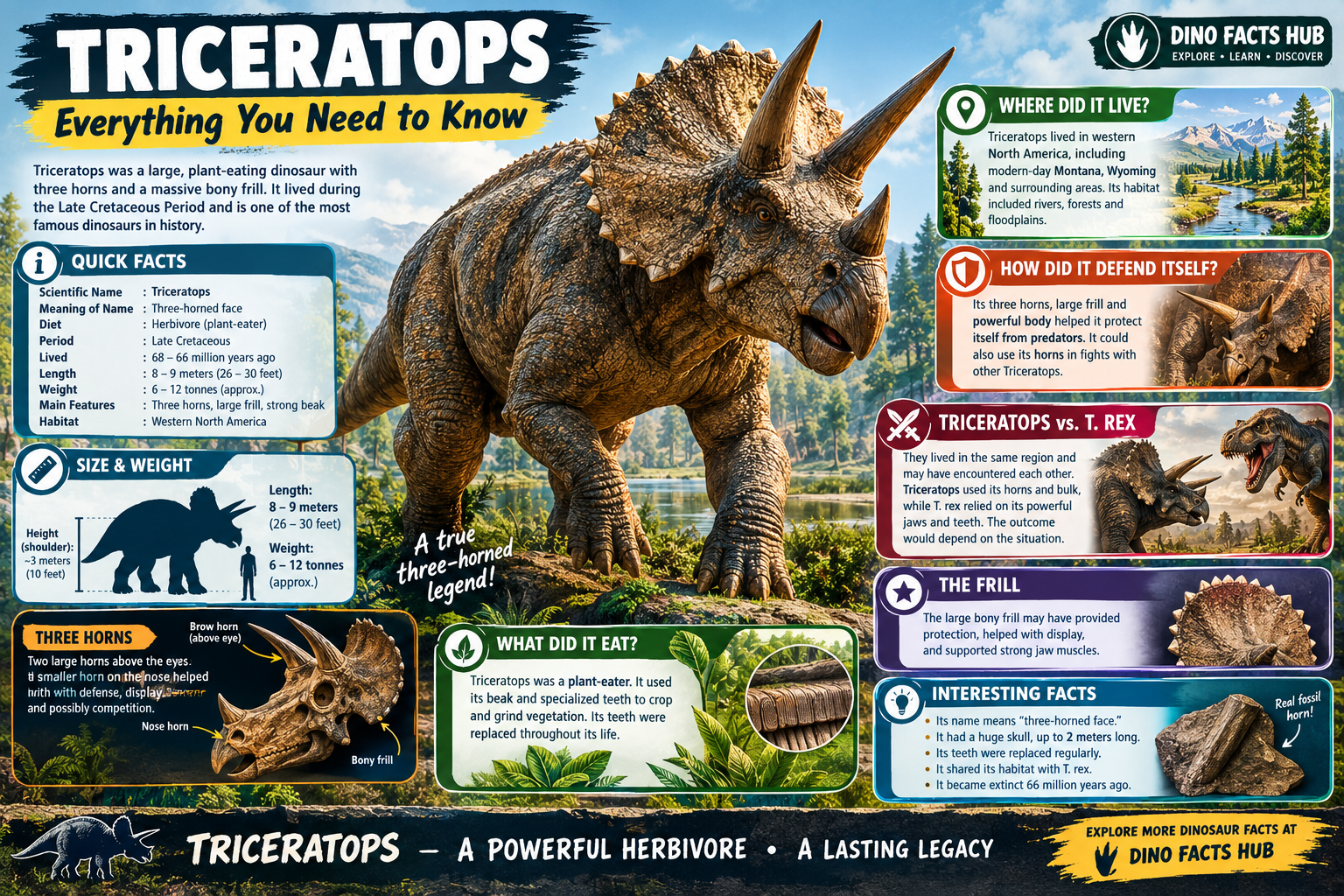
T. rex and Triceratops lived in the same region during the Late Cretaceous Period, making interactions between them possible.
Scientists have discovered Triceratops fossils with injuries that have been investigated as possible evidence of attacks or feeding by tyrannosaurs.
Some healed injuries suggest that certain encounters occurred while the Triceratops was alive.
However, this does not mean every T. rex regularly hunted Triceratops. Large prey could be dangerous, and predators had to balance the potential reward against the risk of injury.
🧠 Was T. Rex Intelligent?
T. rex had a relatively large brain compared with many other non-avian dinosaurs.
Studies of its braincase suggest that it had well-developed sensory systems.
However, comparing dinosaur intelligence directly with modern animals is difficult. Brain size alone does not tell us exactly how intelligent an animal was.
Instead, scientists study brain structure, sensory abilities, behavior, and evolutionary relationships to understand how T. rex may have interacted with its environment.
🌎 Where Did T. Rex Live?
T. rex lived in what is now western North America during the Late Cretaceous Period.
At that time, the landscape was very different from today. The region contained rivers, floodplains, forests, and coastal environments.
T. rex shared its ecosystem with many other animals, including Triceratops, hadrosaurs, turtles, crocodile relatives, and numerous smaller dinosaurs.
It was one of the top predators in these ecosystems.
⏳ When Did T. Rex Become Extinct?
T. rex lived until the end of the Cretaceous Period, approximately 66 million years ago.
It disappeared during the mass extinction event that eliminated all non-avian dinosaurs.
A large asteroid impact near what is now the Yucatán Peninsula in Mexico is strongly associated with this extinction.
The impact caused major environmental changes that affected ecosystems around the world.
T. rex disappeared, but its broader dinosaur lineage did not completely end. Modern birds are descendants of theropod dinosaurs.
🔬 How Do Scientists Know So Much About T. Rex?
Much of our knowledge comes from fossils.
Scientists have discovered:
- Skulls
- Teeth
- Vertebrae
- Leg bones
- Foot bones
- Arms
- Hip bones
- Bite marks
- Trace fossils
- Injured and healed bones
Some T. rex skeletons are remarkably complete, allowing researchers to study its body in great detail.
Modern technologies such as CT scanning, 3D modeling, biomechanical analysis, and microscopic examination have made it possible to learn even more from fossils.
🦖 T. Rex vs. Movie Dinosaurs
Movies often portray T. rex as an unstoppable monster that roars constantly and chases everything it sees.
The real animal was probably more complicated.
Scientists cannot know exactly what sounds T. rex made or how it behaved in every situation. Its hunting strategies, social behavior, and communication are still areas of research.
What we do know is that T. rex was a highly specialized predator with a powerful skull, strong jaws, impressive senses, and a body adapted for life as a large terrestrial carnivore.
Conclusion
Tyrannosaurus rex was one of the most remarkable predators in Earth’s history. It lived around 66–68 million years ago, reached more than 12 meters in length, had enormous teeth and powerful jaws, and probably hunted as well as scavenged.
Although movies have made T. rex famous around the world, fossils continue to reveal new details about what this incredible dinosaur was really like.
From its powerful bite to its impressive senses, T. rex shows just how extraordinary the dinosaur world was.