The Biggest Dinosaurs Ever Discovered
When we think about dinosaurs, it is easy to imagine Tyrannosaurus rex as one of the biggest and most powerful creatures that ever lived. But T. rex was actually much smaller than some of the enormous plant-eating dinosaurs that roamed Earth millions of years ago.
Some dinosaurs grew to incredible lengths and weights. Their necks, tails, and bodies were so large that they make modern elephants look surprisingly small.
Scientists are still discovering new dinosaur fossils, so it is difficult to identify one species as the absolute biggest with complete certainty. Fossils are often incomplete, and estimates of dinosaur size can change as new evidence is discovered.
Let’s explore some of the biggest dinosaurs ever discovered.
🦕 1. Argentinosaurus
Argentinosaurus is often mentioned among the largest dinosaurs ever discovered.
It was a giant sauropod that lived in what is now Argentina during the Late Cretaceous Period, roughly 90–100 million years ago.
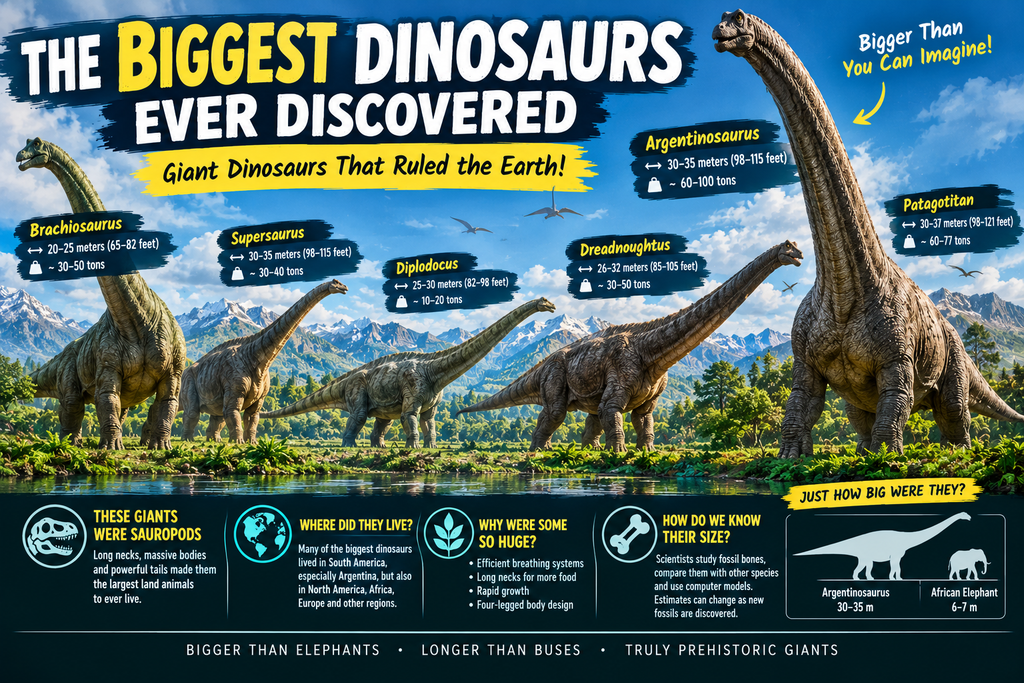
Scientists have estimated that Argentinosaurus may have reached around 30–35 meters (98–115 feet) in length, with mass estimates varying considerably.
Only limited fossil remains have been discovered, which makes estimating its exact size challenging.
Imagine an animal longer than a basketball court walking through a prehistoric landscape. That gives an idea of just how enormous Argentinosaurus may have been.
🦕 2. Patagotitan
Patagotitan mayorum is another spectacular giant from Argentina.
Its fossils were discovered in Patagonia and described by scientists in 2017. It lived during the Late Cretaceous Period, around 100 million years ago.
Patagotitan may have reached roughly 30–37 meters (98–121 feet) in length according to various estimates.
Its fossilized bones show just how enormous sauropods could become.
A Patagotitan femur, or thigh bone, is longer than many adult humans are tall.
🦕 3. Dreadnoughtus
The name Dreadnoughtus means something like “fearing nothing,” which is a fitting name for such a gigantic dinosaur.
It lived in what is now Argentina during the Late Cretaceous Period.
One of the most interesting things about Dreadnoughtus is that scientists discovered a relatively large portion of its skeleton. This gave researchers valuable information about the animal’s anatomy.
Some early estimates suggested an extremely high body mass, but later research has produced more conservative estimates. This is a good example of why dinosaur size estimates can change as scientists study fossils more carefully.
🦕 4. Supersaurus
Supersaurus was a gigantic long-necked sauropod that lived during the Late Jurassic Period, roughly 150 million years ago.
Its fossils have been discovered in North America.
Supersaurus was particularly remarkable because of its extraordinary length. Some estimates suggest it may have reached around 30–35 meters (98–115 feet) long.
Much of that length came from its incredibly long neck and tail.
🦕 5. Diplodocus
Diplodocus is one of the most famous long-necked dinosaurs.
It lived during the Late Jurassic Period in what is now North America.
Diplodocus had a relatively slender body, an extremely long neck, and an equally impressive tail. Some species may have reached around 25–30 meters (82–98 feet) in length.
Unlike some of the heaviest sauropods, Diplodocus had a more lightly built body.
Its long tail may also have played an important role in movement and communication.
🦕 6. Brachiosaurus
Brachiosaurus was another giant sauropod famous for its long neck and tall body.
It lived during the Late Jurassic Period. Its front legs were longer than its hind legs, giving its body a distinctive upward-sloping shape.
Brachiosaurus may have reached around 20–25 meters (65–82 feet) in length and stood more than 10 meters (30 feet) tall in some estimates.
Its height allowed it to reach vegetation that was high above the ground.
🦕 7. Sauroposeidon
The name Sauroposeidon means “sauropod god,” and it certainly lived up to its impressive name.
This dinosaur lived during the Early Cretaceous Period in what is now the United States.
Its extremely long neck vertebrae suggest that Sauroposeidon could have been exceptionally tall.
Some estimates suggest it may have reached a height of roughly 17 meters (55 feet) when holding its neck upward, although the exact posture of a living sauropod is difficult to determine.
🦴 Why Were Some Dinosaurs So Huge?
Scientists have proposed several reasons why sauropod dinosaurs were able to reach such enormous sizes.
Efficient breathing systems
Sauropods appear to have possessed air-sac systems similar in some ways to those found in modern birds. These systems may have helped them breathe efficiently despite their enormous bodies.
Long necks and abundant vegetation
A long neck allowed sauropods to reach vegetation across a wide area without moving their entire bodies as frequently.
Rapid growth
Evidence from fossil bones suggests that some sauropods grew very quickly during certain stages of their lives.
Four-legged body design
Walking on four strong limbs helped distribute their enormous body weight across a larger area.
🧐 Which Dinosaur Was the Biggest?
This question is harder to answer than it might seem.
Scientists usually consider several measurements:
- Total length
- Body mass
- Height
- Bone size
- Completeness of the fossil
- Reliability of the reconstruction
A dinosaur might have been extremely long without being the heaviest. Another might have had a massive body but been shorter.
Species such as Argentinosaurus, Patagotitan, Supersaurus, and Dreadnoughtus are frequently discussed when scientists investigate the largest dinosaurs.
Because many giant dinosaur fossils are incomplete, researchers cannot always determine an exact winner.
🌍 Where Did These Giant Dinosaurs Live?
Many of the largest known dinosaurs were discovered in South America, particularly Argentina.
This region was home to enormous sauropods during the Jurassic and Cretaceous periods.
However, giant dinosaurs were not limited to South America. Large sauropods also lived in North America, Africa, Europe, and other parts of the prehistoric world.
Their fossils help scientists understand how dinosaurs spread across ancient continents.
🐘 How Big Were They Compared With Modern Animals?
The size of these dinosaurs is difficult to imagine.
An African elephant can weigh several tons and is one of the largest land animals alive today. Some giant sauropods may have weighed many times more than an elephant.
Their enormous size was possible because they lived in ecosystems very different from those of today.
They also had specialized skeletons, respiratory systems, feeding strategies, and growth patterns that helped them support their massive bodies.
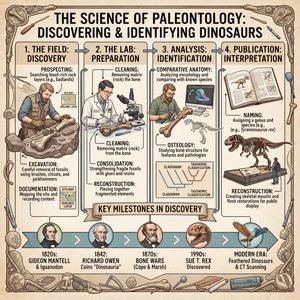
🔬 How Do Scientists Estimate Dinosaur Size?
Scientists study fossil bones and compare them with living animals and other dinosaur specimens.
Important bones include:
- Femur
- Humerus
- Vertebrae
- Pelvis
- Ribs
- Skull
Computer models can also help researchers estimate body volume and mass.
However, these estimates are not always exact. Different scientific methods can produce different results, especially when only part of a skeleton has been discovered.
This is why you may see different size estimates for the same dinosaur.
Final Thoughts
The biggest dinosaurs were truly extraordinary animals. Giant sauropods such as Argentinosaurus, Patagotitan, Supersaurus, and Dreadnoughtus reached sizes that are difficult to imagine today.
But the search for the biggest dinosaur is not necessarily finished.
New fossils are discovered every year, and scientists continue to re-examine previously discovered specimens using modern technology. A future fossil discovery could change what we currently understand about the largest animals to ever walk on land.