When Did Dinosaurs First Appear on Earth?
Quick Answer
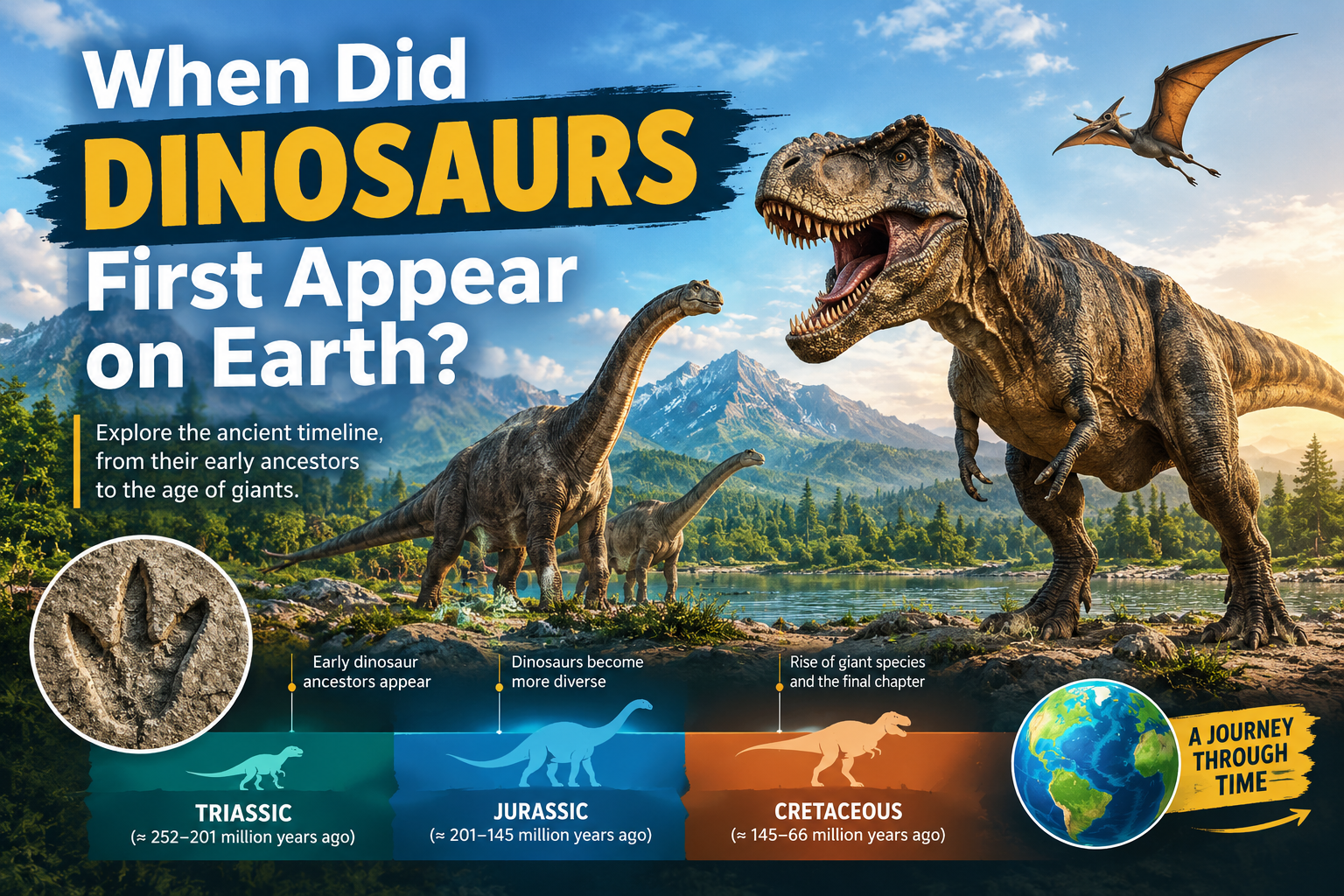
Dinosaurs first appeared roughly 233 to 243 million years ago, during the Middle to Late Triassic Period. The exact date is still debated, because the earliest fossils are rare and the line between “almost a dinosaur” and “true dinosaur” is blurry.
Why Is This Such a Hard Question?
You’d think there would be a simple date, like a birthday. But evolution doesn’t work that way. No single animal gave birth to the first dinosaur on a particular Tuesday. Instead, a group of reptiles slowly changed over millions of years until some of them had the features we now call “dinosaurian.”
Scientists have two problems to deal with:
- Fossils are rare. Only a tiny fraction of living things ever become fossils, and the earliest dinosaurs were small and lightly built, which made fossilization even less likely.
- Definitions matter. Researchers must decide which features make an animal a true dinosaur and which belong to its close cousins.
So when you see different dates in different books, that’s not a mistake. It’s science working with incomplete evidence.
The World the First Dinosaurs Walked Into
To understand where dinosaurs came from, picture the Earth about 250 million years ago.
All the continents were joined into one giant landmass called Pangaea. The climate was hot and dry, with huge deserts in the interior and no polar ice caps. And the planet was still recovering from the Permian-Triassic extinction (about 252 million years ago), the worst mass extinction in Earth’s history, which wiped out roughly 90% of marine species and most land vertebrates.
That disaster cleared the stage. Into the empty ecological spaces moved a new cast of reptiles, and dinosaurs were just one of many groups competing. For a long time they weren’t even the stars. Crocodile-line reptiles, many of them large and fearsome, dominated the Triassic landscape.
Meet the Earliest Dinosaurs (and Their Near-Relatives)
Here are the key fossils that shape our understanding. Ages are approximate and may be refined as new research appears.
| Animal | Approx. Age (million years ago) | Where Found | Why It Matters |
|---|---|---|---|
| Nyasasaurus | ~243 | Tanzania | Possibly the oldest dinosaur, or a very close relative. Scientists still debate which. |
| Staurikosaurus | ~233 | Brazil | One of the oldest widely accepted dinosaurs. A small, agile predator. |
| Eoraptor | ~231 | Argentina | A small, early dinosaur about 1 meter long that shows what the first dinosaurs may have looked like. |
| Herrerasaurus | ~231 | Argentina | A larger early predator, around 3 to 6 meters long, with sharp, curved teeth. |
| Silesaurus | ~230 | Poland | Not a true dinosaur, but a very close relative that helps show how dinosaurs evolved. |
What About Nyasasaurus?
This one is a bit of a puzzle. Fossils from Tanzania suggest an animal that lived around 243 million years ago, which would make it older than anything else with a claim to the title. But the bones are fragmentary. Some researchers say it was a true dinosaur, and others say it was just outside the group. Until more complete fossils turn up, the jury is out.
What Did the First Dinosaurs Look Like?
If you imagine a towering T. rex or a giant long-necked sauropod, adjust your expectations. The first dinosaurs were generally:
- Small, often about the size of a dog or a turkey, though some reached a few meters long
- Bipedal, running on two legs with the arms free
- Fast and light, built for quick movement
- Often meat-eating or omnivorous, with later lineages diversifying into plant-eaters
Their upright posture is one of their big evolutionary advantages. With legs positioned directly beneath the body (rather than sprawling out to the sides like a lizard’s), they could move efficiently and run fast.
Why Did Dinosaurs Succeed?
Dinosaurs didn’t take over the world immediately. For tens of millions of years, they lived in the shadow of other reptiles. So what changed?
1. Climate shake-ups
Around 234 to 232 million years ago, a period of heavy rainfall called the Carnian Pluvial Episode shifted ecosystems worldwide. Some researchers think this helped dinosaurs expand and diversify.
2. The end-Triassic extinction
About 201 million years ago, another mass extinction hit, wiping out many of the crocodile-line rivals that had dominated the Triassic. Dinosaurs survived and spread into the opened-up habitats.
3. Adaptability
Dinosaurs evolved into an enormous range of forms: tiny and giant, fast and armored, feathered and scaly. That flexibility helped them thrive in the Jurassic and Cretaceous.
A Simple Timeline of Dinosaur History
| Time Period | Approx. Dates | What Was Happening |
|---|---|---|
| Permian-Triassic extinction | ~252 million years ago | Worst mass extinction ever; life resets |
| Early-Middle Triassic | ~252-237 million years ago | Dinosaur ancestors begin to appear |
| Middle-Late Triassic | ~243-231 million years ago | First dinosaurs show up (Nyasasaurus, Eoraptor, Herrerasaurus) |
| End-Triassic extinction | ~201 million years ago | Rivals decline; dinosaurs rise to dominance |
| Jurassic Period | ~201-145 million years ago | Giant sauropods and early birds appear |
| Cretaceous Period | ~145-66 million years ago | T. rex, Triceratops, and many more |
| Cretaceous-Paleogene extinction | ~66 million years ago | Non-avian dinosaurs die out |
Did Dinosaurs Really Go Extinct?
Here’s a fun twist that ties the beginning to the end. Non-avian dinosaurs died out about 66 million years ago, but one branch of the dinosaur family tree survived: birds. Every sparrow, pigeon, and chicken is a living dinosaur. So in a real sense, the dinosaur story started over 230 million years ago and never fully ended.
Key Takeaways
- Dinosaurs first appeared about 233 to 243 million years ago in the Triassic Period.
- The earliest known dinosaurs were small, fast, two-legged animals.
- They shared the Triassic world with many other reptile groups and weren’t dominant at first.
- The end-Triassic extinction (~201 million years ago) helped open the door to their rise.
- Birds are the living descendants of dinosaurs.
Frequently Asked Questions
What was the first dinosaur?
There’s no single agreed-upon answer. Nyasasaurus is a candidate for the oldest, while Eoraptor and Herrerasaurus are among the best-known early examples.
Which period did dinosaurs first live in?
The Triassic Period, which lasted from about 252 to 201 million years ago.
Were the first dinosaurs big?
No. Most early dinosaurs were small to medium-sized. Giant forms came much later, in the Jurassic and Cretaceous.
How do scientists know how old fossils are?
They use radiometric dating of volcanic rock layers around the fossils, along with the position of the rock layers in Earth’s geologic record.
Learn More: Trusted External Resources
- Natural History Museum, London: Dinosaurs
- American Museum of Natural History: Dinosaurs
- Encyclopaedia Britannica: Dinosaur
- UC Museum of Paleontology: The Triassic Period
- USGS: Geologic Time
- International Commission on Stratigraphy: Geologic Time Scale
Dates in this article are approximate and reflect current scientific estimates, which may be updated as new fossils are discovered.