
How Long Did Dinosaurs Live on Earth?
Dinosaurs are among the most fascinating animals in the history of our planet. They lived millions of years before humans appeared and became one of the most successful groups of land animals ever known.
But exactly how long did dinosaurs live on Earth?
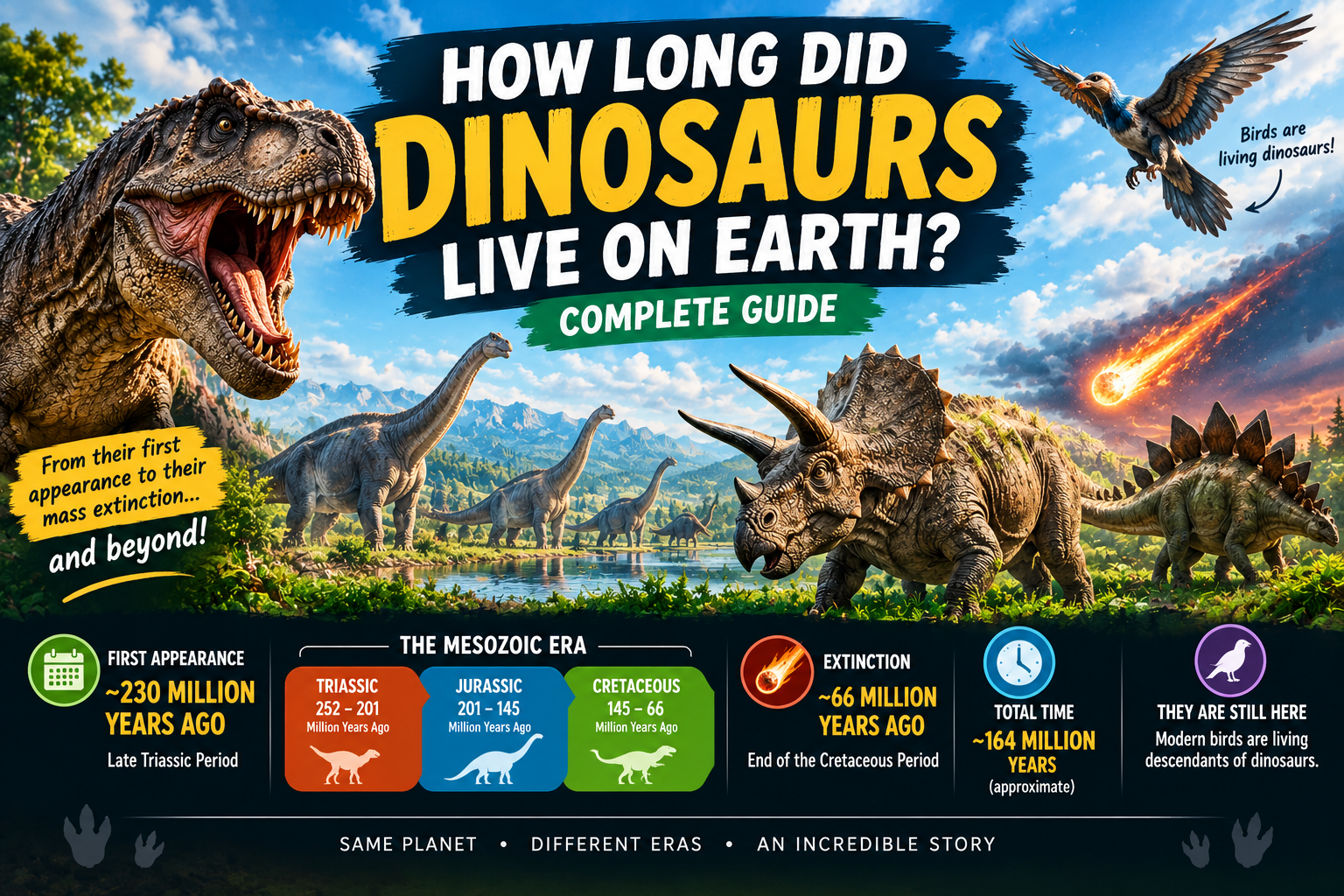
The answer is surprisingly long. Dinosaurs first appeared around 230 million years ago and non-avian dinosaurs disappeared about 66 million years ago. That means dinosaurs dominated Earth for roughly 165 million years.
And there is an interesting twist: scientifically speaking, dinosaurs did not completely disappear. Modern birds are considered living dinosaurs and are descendants of theropod dinosaurs.
When Did Dinosaurs First Appear?
The earliest dinosaurs appeared during the Late Triassic Period, approximately 230 million years ago.
At first, dinosaurs were not the dominant animals on Earth. They lived alongside many other reptiles and prehistoric animals. Early dinosaurs were generally smaller than some of the enormous species that evolved later.
Over millions of years, however, dinosaurs diversified and adapted to many different environments.
The Three Major Dinosaur Periods
The time when dinosaurs lived is part of the Mesozoic Era, which is divided into three major periods.
1. Triassic Period
The Triassic Period began about 252 million years ago and ended around 201 million years ago.
The earliest dinosaurs evolved during this period. They were generally smaller and less dominant than many of the dinosaurs that appeared later.
Toward the end of the Triassic, a major extinction event affected many competing animal groups. Dinosaurs survived and became increasingly important in terrestrial ecosystems.
2. Jurassic Period
The Jurassic Period lasted from approximately 201 to 145 million years ago.
This was a remarkable period for dinosaur evolution. Many large herbivorous dinosaurs appeared, including long-necked sauropods. Large carnivorous dinosaurs also lived during this time.
The Jurassic world contained forests, rivers, floodplains, and other environments where dinosaurs could thrive.
3. Cretaceous Period
The Cretaceous Period lasted from about 145 million years ago until approximately 66 million years ago.
During this period, dinosaurs became extremely diverse. Famous species such as Tyrannosaurus rex, Triceratops, and Ankylosaurus lived during the later part of the Cretaceous.
The period ended with a major mass extinction that eliminated the non-avian dinosaurs.
So, How Long Did Dinosaurs Actually Live?
From their first appearance around 230 million years ago until the extinction of non-avian dinosaurs around 66 million years ago, dinosaurs were part of Earth’s ecosystems for approximately 164 million years.
The exact number can vary depending on which fossils scientists consider the earliest dinosaurs and how their evolutionary history is defined.
Either way, their time on Earth was incredibly long.
For comparison, modern humans have existed for only a tiny fraction of that period.
Did All Dinosaurs Live at the Same Time?
No. This is an important point.
A common misconception is that T. rex, Stegosaurus, and Brachiosaurus all walked around together. In reality, many famous dinosaurs lived millions of years apart.
For example, Stegosaurus lived during the Late Jurassic, while Tyrannosaurus rex lived during the Late Cretaceous. They were separated by tens of millions of years.
This is similar to comparing animals that lived during very different periods of human history.
How Long Did Individual Dinosaurs Live?
There is a difference between asking how long dinosaurs existed as a group and how long an individual dinosaur lived.
Scientists cannot determine the exact lifespan of every dinosaur species. However, fossil evidence can provide clues.
Some dinosaur bones contain growth rings or changes in bone structure that can help researchers estimate the age of an individual when it died.
Scientists have suggested that dinosaur lifespans varied considerably depending on the species. Smaller dinosaurs may have matured relatively quickly, while some large dinosaurs probably took many years to reach adult size.
Therefore, there was no single lifespan that applied to all dinosaurs.
Why Did Dinosaurs Survive for So Long?
Dinosaurs were remarkably adaptable. Over millions of years, they evolved into animals with very different body sizes, diets, behaviors, and physical features.
Some were:
- Huge plant-eating sauropods
- Fast-moving predators
- Small feathered dinosaurs
- Heavily armored herbivores
- Horned dinosaurs
- Long-necked browsers
- Early bird-like species
Their diversity allowed different dinosaur groups to occupy many ecological roles.
What Happened 66 Million Years Ago?
Around 66 million years ago, Earth experienced a major mass extinction at the end of the Cretaceous Period.
A large asteroid struck near what is now the Yucatán Peninsula in Mexico. The impact was followed by major environmental changes that affected ecosystems around the world.
Many species disappeared during this event, including the non-avian dinosaurs.
However, one dinosaur group survived.
Dinosaurs Are Still Alive Today
This may sound surprising, but birds are living dinosaurs.
Modern birds evolved from theropod dinosaurs. This means that dinosaurs as a broader evolutionary group did not completely disappear 66 million years ago.
Instead, one branch survived and continued evolving.
So when you see a pigeon, eagle, sparrow, or chicken today, you are looking at a modern member of the dinosaur lineage.
Why Is Dinosaur History Important?
Understanding how long dinosaurs lived on Earth helps us appreciate how dramatically life can change over geological time.
For more than 160 million years, dinosaurs evolved through changing climates, shifting continents, volcanic activity, new ecosystems, and multiple extinction events.
Their fossil record gives scientists valuable information about evolution, extinction, ancient environments, and the history of life on Earth.
Final Thoughts
Dinosaurs first appeared roughly 230 million years ago, and non-avian dinosaurs disappeared around 66 million years ago. That gives dinosaurs an incredible history spanning approximately 164 million years.
During that time, they evolved from relatively small early species into an enormous variety of animals, including some of the largest creatures ever to walk on land.
And although the famous non-avian dinosaurs eventually disappeared, their story did not completely end. Their descendants are still with us today in the form of modern birds.
Keep exploring Dino Facts Hub to discover more fascinating stories about dinosaurs, fossils, prehistoric life, and the amazing history of our planet.
